Monday, May 12, 2014

F**K YOUR FEELINGS

In our current culture, we have grown to become more in tune with our feelings.  We are encouraged to process our feelings, not bottle things up, and express our feelings whenever possible to share with others.  Our feelings are good, and having them hurt is bad, and those in turn who would seek to hurt our feelings are “bullies”, of which we have no tolerance.


We may be here a while

However, we need to understand that our feelings are not reality, they are simply a perception of reality.  As such, to allow them to dictate how and why we train is foolish, as we will ignore real data for that which is greatly misleading.  In many cases, how we feel is merely an approximation of reality, and not a close one at that, meaning that to trust it is to err too far on the side of caution.

Many trainees base how they train purely on how they feel.  If, after a workout, they do not feel that they got enough of a workout, they either add more or they change workouts.  The “feeling” of working out enough is inconsequential, one either did or did not work out enough.  You should not feel one way or the other about this matter, you simply should do or not do.  We see this same instance with trainees claiming that they do not feel as though they are gaining strength fast enough.  This is not a feeling, it is a data point, one that we can (and should) chart.  To leave the measuring of our progress to feeling rather than actual quantifiable metrics is foolish to the point of insanity.  We must not rely on feelings, but on reality.


Because, sometimes, what's really happening doesn't map onto what we think is happening

Feelings also lead us astray when we have no actual frame of reference.  I have witnessed many trainees who refuse to squat low bar because they claim it feels like the bar is going to slip off their back.  These trainees have never actually had a bar slip off their back to know what that actually feels like, but they somehow claim to know that the sensation they are presently feeling is that feeling.  I have known other trainees that refuse to press with a certain grip width because, to them, it feels like their shoulder is about to dislocate.  As someone with 6 shoulder dislocations, I can tell you that I never knew what it was going to feel like before it happened, only after.  These people trust their feelings over their experiences, placing their faith in an idea they have never witnessed versus believing in a reality that they have actually experienced and can replicate.  Is this not madness?

Other times, we use our feelings as a justification to do less, as though a feeling is in and of itself enough of a reason to stop an action.  A trainee may claim that they must stop conditioning because they feel like they are going to throw up.  Often times, when given the opportunity to throw up anyway and just keep training, we find that these trainees still had quite a bit more left in them, and that all they were experiencing was the fear of pain.  A trainee actually pushed to the point of vomiting tends to find the experience too rapid to be able to complain about, and tends to also be driven enough to keep moving anyway.  In other cases, a trainee may stop using a certain technique because they feel pain.  I have many times seen a trainee say that they can’t low bar squat because they feel pain in their wrists or shoulders, as though that is reason enough to stop.  I contend that, as long as one can continue moving through the plan of movement, they can continue lifting, and it is simply up to them to endure the pain and grow stronger.  The sheer presence of discomfort is not a reason to stop an activity, it is simply a part of the experience.


Your feelings are not data points.  What you feel is not justification to start or stop an activity.  How you feel about your progress is immaterial to if you are or are not progressing.  Your feelings do not give you a pass, nor do they dictate your success.  It is up to you to perform in spite of your feelings, and to recognize what is real, and what is simply perception.

In short, f**k your feelings.

Sunday, May 4, 2014

DO NOT CONFUSE CONVENTION FOR INTENTION

In our society, we are witnesses a reverence for the traditional that runs counter to how culture tends to normally progress and guides our actions in many facets of our lives.  Whereas typically it was the case for the current generation to look upon the past generations as foolish, evil, uneducated, and in general not worth emulating, we are instead witnessing a case where we take such great offense at the failure of our current state of affairs that we assume that any previously employed method must be better than the ones we currently utilize.  Whether it being way back toward our foundational ancestry and embracing the “Paleo Lifestyle”, or even simply embarking back to the “Golden Era” of hardcore training in the 60s and 70s, a return to “how things were” is being embraced, and a rejection of “how things are” is present.

What we must keep in mind when viewing the lifestyles and actions of the past is that the choices made by these people were framed within the access they had to other options.  Our idols of the past were not intentionally choosing to live a Spartan existence.  Quite the contrary in fact, these people attempted to maximize their lives as much as they possibly could, they simply did not have access to many of the concepts, products, ideas and theories that we have come into at the present.  To think that Paleo man, if given the choice between hunting and gathering and sitting down at Taco Bell for a #3 would choose the former out of some reverence for “tradition” and “legitimacy” is foolish, he did what it took to expend the bare minimal effort for maximal results.


Of the above, which do YOU think Paleo man would go for?

When speaking of lifting, we must utilize this understanding when it comes to analyzing and implementing the various tools and methods presently available to us that were not necessarily present or readily in the past.  In many cases, we fall into the trap thinking that the best way to get bigger and stronger is the always employ barbell work, heavily focused on the big 3 (squat, bench press and deadlift), because that’s how things were always done.  The notion of starting with a safety squat bar for squats, swiss bar for deadlifts, and mat pulls for deadlifts is considered laughable, because those are “advanced movements” that you’re supposed to do once you’ve developed an ability in the basics.

Why though?  What is history had been different, and somehow we decided to make the safety squat bar first before the barbell.  Would no one ever do squats until a barbell was invented, or would the barbell be considered “advanced” since its development came about after the safety squat bar?  Are bands and chains advanced, or did they simply come about later in history?  Is walking a squat out more "pure" than squatting out of a monolift, or did we simply walk squats out because we had to?  Does a linear timeline dictate rate of progression, or does it simply offer a historical perspective that, though fascinating, has no bearing on our training?


I'm fairly certain that the people with the surf boards could actually travel faster on land than this guy

When emulating the greats of the past, we should not emulate their methods, but instead their mentalities.  They did whatever it took to get bigger and stronger, and used all of the tools available to them to their maximal benefit.  Had there been more tools available, they would have used them as soon as they were valuable to them, not intentionally eschewing them because they were “impure”.  There is nothing magic or hardcore about a barbell and some iron plates, it was simply what was there at the start.

In your training, do not give in to the pressure of others who shout down your methods because it was not how it was done in the past.  We have advances available to us, both technological and theoretical, that can allow us to avoid many of the issues others had to contend with in the past to become even greater, and to ignore their validity simply due to their recency in the training timetable is purely a support for anachronism in ones own life.  Until the early 1900s, man lacked the ability to fly.  By 1960, he had flown to the moon.  Are we to assume that the desire for flight had lacked in man all the way until the Wright Brothers managed to feat, or should we instead conclude that, had man be given the opportunity at their onset, they would be airborne?

Sunday, April 27, 2014

BEING WRONG MAKES YOU STRONG, BEING RIGHT MAKES YOU WEAK

At some point in our timeline, the notion of “wrong” became synonymous with “evil”.  It becomes easy to equate the two, and in many cases we assemble “right and wrong” and “good and evil” in the same sentence and thought process, usually in order to assert that we are both aligned toward what is right and what is good.  The unfortunate consequence of this mentality is that we now equate being wrong about anything with being evil, and have attributed a moral quality to a concept that is inherently factual.  There is no morality in being wrong, nor is there any sin committed in having wrong ideas, and as such, the attempt to avoid being wrong at all costs is in turn an attempt to avoid ever learning, growing or evolving.


You aren't evil for going this way, you're just probably going to die

The negative implication of this inherent need to always be right is the behavior it encourages and reinforces.  When presented with information wherein it may seem that we are wrong about an idea we currently maintain, rather than further explore this new idea to witness if it maintains any merit, we instead relentlessly research all information that will confirm our current belief system in order to bolster our mental defenses.  We sacrifice all of our other principles, to include objectivity, rationality, and in many cases simple human decency and benevolence, in order to ensure that we do not commit the cardinal sin of ever being wrong.  In doing so, we squander all of our opportunities to grow.

There is freedom in being wrong, and in fact, being wrong about something is one of the most liberating sensations in the world, assuming one has found success with their current belief and approach.  A successful person who finds out they are wrong has zero need to fear the implications of being wrong, and instead only joy in discovering what is right.   If one has found success by doing the wrong thing, then most surely, upon using the right method, their success will grow even more exponentially, no?  Would this not mean, then, that the absolute best situation for a trainee to be in is one in which they are wrong, for their potential is nowhere near exhausted?  Oh what a tragedy it would be to discover that one has been right all along, and that they have already achieved all they possibly can using the absolute most perfect methods and ideas available to them.  How is THAT not instead the most evil scenario, with being wrong actually being the preferred ideal?


Could you even imagine how big Arnold's biceps would have gotten had he stopped doing curls the wrong way and started doing them the right way?

It is only the unsuccessful who fear being wrong, for it merely confirms what their lack of success has already been dictating to them.  An unsuccessful trainee is clearly wrong by nature of their own lack of success, yet they will argue to the death how “right” they are, for it is the only means of success they have available to them.  Despite their own inability to progress, they have research, examples, stories, myths, legends, anecdotes, studies, and all manner of hearsay and conjecture which confirms beyond the shadow of a doubt just how right they truly are, and how the rest of the world is wrong.  Though it would be un-obvious to even the most learned observer, this failed specimen is actually the most right on all arguments about the subject, and will gladly explain to you on an intellectual level how right they are, due to the fact that, on a physical and obvious level, there is no evidence.  It is the fear of admitting that they have failed up until this point that drives these trainees to find newer and more creative mental gymnastics necessary in order to prove to themselves how right they are, for otherwise, their time being wrong has been squandered, whereas the successful trainees time being wrong was well spent.

I ask you, what possible benefit is there in being right, if it means you are weak?  Wouldn't it be far more preferable to wrong and be strong?  I cannot wait to find out what else I am wrong about, because it means I have another chance to become even bigger and stronger.

Monday, April 21, 2014

TRAINING MOVEMENTS FOR THE NON-COMPETITIVE LIFTER PART II: UPPER BODY

In part I of this series, I covered the two lower body lifts (squat and deadlift variations) that I would choose to train if I did not want to compete in strength sports.  Here we will cover the two upper body lifts that I need to train for competitions, and what I would do if I did not have to train them.

1:  What I have to train: The bench press


What I would rather train: parallel bar dips


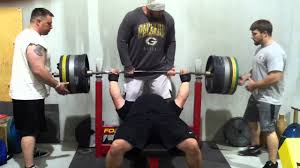
Why:  I realize that the bench press has been a staple in every red blooded American’s trainee, but in reality, I find the movement leaves a lot to desired.  As much as many people want it to just be “lie down and press”, the reality is that good benching necessitates a lot of work.  Arching, shoulder blade retracting, leg drive, pulling the bar apart, etc etc, there are a million different things going on at once here, and getting a good bench means putting in a lot of work into the skill of benching, not necessarily high on the list of someone who simply wants to become bigger and stronger.


Oh yeah, also, don't forget to breathe

Additionally, there will always be the “fear factor” of benching, in that it is a movement where we suspended the heavy barbell over our bodies from arm’s length height, rather than having it underneath/beside us like in the deadlift or connected to our body like the squat.  It becomes difficult for a trainee to really push themselves hard on this lift without a spotter due to fear of consequences.  WITH a spotter though, we run into a whole new gamut of issues wherein overly eager spotters grab the bar before a struggle begins, leaving the trainee to wonder if they actually lifted the weight themselves or if they needed assistance, which makes self assessment and monitoring difficult.  On the topic of difficulty is self assessment, we can also discuss how ideally a bench is paused, but in practice it is a touch and go movement, and herein the potential exists for trainees to simply become better at bouncing the weight off their sternum (regardless of the safety issues with this practice) rather than actually getting stronger at the bottom of the lift, meaning that more weight can be lifted week to week, yet more strength is not actually being developed.  From all of this, I genuinely do not feel the bench is a worthwhile movement for trainees who simply desire size and strength.

The parallel bar dip avoids many of these issues.  The movement is far less technical than the bench press, mainly because one is not making use of a bench in the movement, and therefore there is no need to try to incorporate said bench into their execution.  A trainee cannot drive their heels into the floor, nor can they drive their traps into a bench and force an exaggerated arch by being on their toes, they simply are dipping up and down on a set of bars.  Yes, some technique is required, but not nearly as much.  Less time focusing on getting better at dips is more time spent getting bigger and stronger USING dips.


Maybe...maybe using too much dip

The fear factor from bench is totally eliminated as well, for if the weight is too heavy, you just fall down to the floor and terminate the set.  This means far more effort/intensity can be put into each set, and sets to failure/past failure are very easy to include.  A spotter is totally unnecessary here, and the movement is similar to a squat, where one dips down to a point and immediately springs up, meaning there is no debate on pause vs. no pause, letting strength progression be easier to track.  There is an inability to use ones’ anatomy as a springboard here as well, so even if you are getting a stretch reflex at the bottom of the lift, you’re not risking your sternum to do so.  Progression can become a little cumbersome here, as weights on a dip belt can get awkward at higher poundages, but that is honestly a good problem to have.  If you are at the point where the weights on your dip belt are getting in the way of your movement, you most likely got pretty big and strong.

In general, I prefer very closely spaced together parallel bars.  My right shoulder is a mess, and the closer the bars, the easier on my shoulders.  Some trainees prefer wider spacing and an angle.  Find out what works for you.

2:  What I have to do: Log/axle pressing


What I would do instead: Log/axle pressing


Why:  There is nothing to change here, strongman got it right all along, and one of my biggest regrets is not using these movements sooner.  I will discuss the benefits of both the log and the axle here.

The axle:  The axle is essentially a fat grip barbell with no rotating sleeves.  I spent time with a regular barbell with fat gripz, thinking it would be similar, but once I made my own axle and gave it a try, they didn’t compare at all.  The squishiness of the fat gripz isn’t here at all, which makes pressing feel much more secure in general.  Additionally, the wide diameter of the bar is very easy on the joints, specifically the elbows, which is great if yours are beat up from years of pressing with barbells.  I use a thumbless grip with all of my pressing, and it’s totally manageable with the axle.  The lack of rotating sleeves can be a factor if you clean the bar, but don’t really hinder pressing to a significant degree.


Hell, sometimes a lack of sleeves can be a good thing

Finally, one of the biggest selling points of the axle is the fact you can make one for about $50.  Get a piece of 2” galvanized steel pipe cut to slightly over 7’ and use duct tape to make sleeves on either side.  You can use hose clamps too to accomplish something similar.  After I made my axle, I kicked myself for not having one for years.

The log: This is awesome for a completely different set of reasons.  The log, in my opinion, is the perfect pressing implement for people with messed up shoulders.  This is the case for two reasons, the first of which being the neutral grip built into the log.  By pressing in this fashion, your hands are kept rotated in a more natural position, putting far less strain onto your shoulders compared to the grip one normally experiences with a straight bar.  The second benefit of this bar is the fact that the handles are buried deep into the log, meaning your hands will naturally rest much higher up when the log is on your chest.  This functions in a similar capacity to the “shoulder saver” bar/pad that elitefts sells, in that it forces you to always perform a partial press that bypasses the lowest portion of the chest, which is where a lot of pain/damage occurs with previously injured pressers.  It is comical that these features are what tend to bother people with healthy shoulders when it comes to the bar, forcing it to be considered “unwieldy”, because when a jacked up trainee attempts to utilize the log, it feels absolutely perfect.  This means that the time spent training the log press is time spent building big and strong shoulders.


Plus, you can't argue with that

Though the pressing of the log can be considered more technical than a straight bar press, which is something I tend to shy away from for the non-competitive athlete, what really shines about the log from a “non-technical” aspect is the cleaning of it.  As someone who is totally lacking in coordination, I can clean a log with much greater ease than a barbell.  Whereas the barbell requires triple extension, the log can simply be rolled up the body with a total lack of finesse, meaning, if one does want to train a floor to overhead type of movement (especially for something like tabata work), the log is a champ.