Tuesday, January 19, 2016

BEING LAZY DOES NOT MAKE YOU HARDCORE PART III: EATING AND SLEEPING


Once more it becomes time to address the advice that is given under the pretense of “hardcore” while in reality simply being an excuse for laziness.  In this instance, it’s not simply the participant that is guilty of sloth, but the advice giver as well.  I am, of course, referring to the advice that, anytime a stall occurs, the solution is to eat and sleep more.


Medical coma and a feeding tube: the dirty secret to anabolism


First, yes, in most cases, eating and sleeping more will allow you more progress than taking the alternative route.  This is because food is used to make muscle, and sleep is when muscle is made.  The thing is, it makes this advice lazy and worthless.  Yes, great, eating and sleeping more will allow you to make more progress.  This isn’t addressing WHY there is a lack of progress, it’s simply providing a cure all.  It would be akin to saying “up your dose”. A true plateau buster, but not at all addressing the problem.

Plateaus and stalls occur for a variety of reasons, and most often a solution can be discovered in the programming and training rather than simply the recovery.  Jumping straight to more food and sleep is an act of intellectual sloth, refusing to take the time to consider the impact of how one trains in pursuit of their goals.  Maybe we’re not using enough volume, or our conditioning is sub-par, or we’re squatting too high, or we’re using the wrong assistance approach, or a variety of other possibilities.  Having to think about and through these things requires time and effort, and it’s far easier to ignore everything, keep training exactly the same way, and just solve all problems by eating and sleeping more.

This lazy problem solving method is also utilized by zealots as a means to scream down any opposition to their method.  It’s even become a meme now “YNDTP” (you’re not doing the program) or “YNDTFP” if you’re super edgy; because now we’re become so lazy we can’t even take the time to type out our insults.  The zealots, and even the authors, will shout this at anyone who dares deviate from their sacred programming, and explains that the reason they aren’t progressing isn’t due to programming not suited toward progress, but instead simply a result of not eating and sleeping enough.  Once again, doesn’t this solution work universally with ANY program?  Aren’t we admitting, by extension of the fact that this is the ONLY solution to the problem, that therefore the program IS terrible?  


I honestly just got tired of the Starting Strength meme, but you knew where I was going with this


Allow me to offer my own lazy advice at this juncture: conditioning and vegetables.  Why these two words?  Because 99% of the time, whenever I observe a trainee stalling, they aren’t engaging in any sort of conditioning, nor are they eating any vegetables.  Why is this the case?  Because, in predictable fashion, upon following the advice that recovery is the only solution to training stalls, these trainees have decided to avoid all extra activity outside of lifting AND they are eating a diet that is only fixated on calories and macros, completely ignoring the benefits of micronutrients.  Clearly those 3 sets of 5 reps are all the training one needs to grow, and it taxes ones recovery to such an incredible degree that one needs to mainline 6000 calories a day to grow, which means no room for anything green.  Christ, I’ve actually observed trainees asking what the point of eating veggies is since they don’t have many calories or macronutrients, a clear sign that their parents failed them at the dinner table.

As I said in my last post, conditioning is crucial to recovery, and the takeaway is that you can actually TRAIN your body to recover from training.  Recovery isn’t simply a passive pursuit, accomplished by nutritional surplus and an excess of sleep, but a trainable quality.  This is one of those things we KNOW instinctively, and have to be convinced by the “hardcore” crowd is untrue.  We KNOW that, with hard work, we can accomplish our goals, but the hardcore crowd MUST have it the other way: that the only path to success is through sloth and LESS work.  They pride themselves on their slovenly physiques that result from their nutritional laziness, deriding those with abs as “pretty boys” and other such derogatory terms, utilized as a defense mechanism to cope with the cognitive dissonance one meets when they are doing everything “right” and yet look terrible and have no results to show.  Only the completely deluded could possibly accept such insanity.  


Yo


It’s far easier to turn to food and sleep to solve one’s problems than to actually IDENTIFY the issue in order to find an adequate solution.  However, as we know, using the easiest method does not result in the greatest outcome, and instead is simply a recipe for mediocrity.  In almost all situations, hard work will trump hard rest.  

Saturday, January 9, 2016

BEING LAZY DOES NOT MAKE YOU HARDCORE PART II: REST TIMES


Once again I must address this notion that working LESS somehow makes you more hardcore than those who work MORE. Today’s topic: rest times.


I frequent lifting forums these days mainly to acquire fodder for this blog, and this week I was graced with just such an opportunity.  A trainee was wondering why they were so fatigued during their training, and the prevailing wisdom of the internet was that this trainee was not resting enough between sets.  When the idea of improving conditioning was brought up, it was mocked, decried, crucified and stomped upon, because that’s not how you get bigger and stronger. No no, the only way to get stronger is to rest more between sets.


Image result for rip van winkle 
Getting so jacked!


People were actually bragging about how long they rested between sets.  A trainee with a 375lb squat dutifully informed me that he didn’t need to work on his conditioning, and that instead he just needed to rest 8-10 minutes between sets.  This same person informed me that it took him 45 minutes to do 3 sets of 5 on squats.


45 minutes to do 3 sets? Christ almighty, can you imagine how long this person takes to do a real workout? Would they ever even leave the gym?  Oh, but fret not, because the answer is obvious: since you’re resting so long between sets, you just need to do fewer sets in order to maximize recovery and minimize time spent in the gym.  After all, you’re “working hard” during those 3 sets.  Let us also not forget that one needs to mainline 6,000 calories a day to be able to recover from such brutal workouts.


There is a reason this is a meme


Folks, this is the logic of the fat and the weak.  It’s a creative way to make working less seem hardcore through mental gymnastics and sophism.  If you’re resting 8-10 minutes between sets, you’re not “working hard”; you’re out of shape. This is especially true if you’re using paltry poundages.  I realize that a lot of weak folks like to point out that weight on the bar doesn’t matter, only the percentage as it relates to your max does, but that’s clearly insanity.  Dave Tate has constantly pointed out that you can get a beginner to do 10 reps of 80% of their 1rm and they’ll be fine, but if you try to get a 1000lb squatter to do the same, you’re going to have to scrape them up off the floor.


Instead of taking pride in how long you rest, take pride in how LITTLE you need to rest to be able to crank out sets of the same intensity, one after the other.  This is accomplished by actually focusing on your conditioning and working to become *gasp* an athlete.  I know many internet kids like to sit back with their Chuck Taylors on, scarfing down McDoubles and talking about how they ARE athletes because they go to the gym 3 times a week and do Starting Strength, but let’s be honest for a second; no actual athlete trains/eats like that.  Hell, even the powerlifters that these kids THINK they’re being don’t train and eat like that.  The only people acting this way are non-athletes, whose only form of exercise is an INCREDIBLY limited weight training regimen with enough rest between sets to prevent ANY sort of sustained elevated heart rate.


The counter-argument is always about this terrifying fear of “losing gains”.  Can’t do ANY sort of conditioning, because it’s going to negatively impact recovery, sap into nutrition, and ruin progress in the weightroom.  Once again, another creative way to make skipping out on work seem hardcore.  You really want to believe you train SO hard that you couldn’t possibly perform a 15 minute circuit, or a tabata drill, or pull a sled or push a prowler, or go on a WALK?  How is it that some 19 year old kid only squatting 300lbs is pushing their body to the max, while there are Navy SEALS, elite athletes, firefighters, and all sorts of other folks grinding it out day after day? 


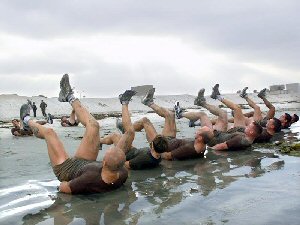
These guys are far too hungry, sleep deprived and delirious to worry about overtraining

Contrary to popular belief, you WILL get stronger by training MORE.  It’s so incredibly difficult to overtrain, and yet with all this fear of overtraining, there seems to be minimal concern regarding the epidemic of undertraining.  If you push your body, you’ll force it to make one of two decisions: adapt or break. I assure you, when push comes to shove, it will pick “adapt” far more often than break. And once you start adding in conditioning work, your recovery between sets gets better, which means you can have greater training density when you lift, allowing more volume/more work to be done and more progress to be made.


Or you could do 3 sets in 45 minutes.  I’m sure that’s really effective too.  Sounds hardcore.

Friday, January 1, 2016

YOUR QUESTIONS ANSWERED: BEGINNERS

I’ve always opened the floor to my readers to ask me any questions they want addressed, and SeanR has taken me up on the offer, having left a question in the comment section of my most recent post.  In order to try to stay on point and not go off on too much of a tirade, I will be addressing his question in parts.  Here is the question in its entirety.


I was hoping for your next blog if you could touch on what a beginners first year of training should look like. Lets say they have played some sports and have messed around in the weight room, but now they are starting from ground zero. Also what weight range in the major lifts do you think a person should have after 1 year of training hard if they started as a beginner. 


And now to break it down a little bit

I was hoping for your next blog if you could touch on what a beginners first year of training should look like. Lets say they have played some sports and have messed around in the weight room, but now they are starting from ground zero.


You can tell Sean is an avid reader of mine already because he’s already addressed one of the primary things I advocate ALL trainees do before lifting: play some sports and perform some basic bodyweight training.  I’ll still harp on it here while on the topic of beginner trainees though.  If I were to craft the perfect strength super soldier, I’d want them to spend at least 2-3 seasons playing some sort of athletic competitive sport.  Something with a lot of full body movement, resisting opposing forces, and some contact.  American football, wrestling, basketball, rugby, the basics/classics. 


No


You gain a lot of skills and experience from this that carries over very well into the weight room (tenacity, body awareness, coordination, flexibility, mobility, etc etc).  Additionally, one of the other huge benefits of this is you learn the difference between being sore and being injured, which is something a LOT of beginners seem to struggle with, having never actually BEEN injured before.  I remember after my first day of football practice as a high school freshmen I was so sore I couldn’t even get out of bed, but I also knew at that point that I wasn’t injured, and I just limped onto the field, warmed up, and was good to go again.  Getting all of this knocked out ahead of time means that time spent in the weight room isn’t wasted trying to figure out your body.  So many beginner trainees spend the first few years spinning their wheels because they don’t even know the very basics about ANY sort of training, and at least with sports you’ll get SOMETHING out of that time, while spending 3 years resetting on Starting Strength is far less valuable.


Alright, let’s actually talk about the question.  It’s true I’ve written my own beginner programs in the past, and advocated for a few as well, but these days, were I to start all over, I’d honestly just run 5/3/1.  I’ve been a pretty vocal proponent of 5/3/1 recently, and it’s not because there is some sort of magic formula in the percentages or anything like that, but more that Jim Wendler really figured out some great principles to base ANY training program around and put them all together.  Starting light, focusing on PRs, building strength in sub maximal ranges, using assistance work without obsessing over it, basing training around 4 big movements, valuing conditioning, scheduled deloads, all that stuff is just gold. 


I’ve had a fair series of blog posts recently addressing my issues with the current market of “beginner programs”, and basically the obsession with always adding weight to the bar is just building a bunch of kids who know how to peak their strength but have zero idea how to actually build it.  It makes sense that Bill Starr used these programs for off-season football players, because it was a quick way to get them back to their old strength numbers before the season started again, but for an athlete who is more focused on weights versus football, there are better ways forward.  Additionally, there is a LOT to learn from something like 5/3/1, with all the exploration and experimentation available, and as long as one puts in the effort in the main sets, they’ll grow.


And this crap will stop happening


As for WHAT version of 5/3/1 to run, I’d honestly just plain have them do the 4 day vanilla 5/3/1 to start, with the BBB assistance work.  I’d swap out BBB deads with another type of squat (so have them doing squats and SSB squats as an example), and I’d have them do the alternate exercise for assistance (so do BBB press on 5/3/1 bench day, BBB squat on 5/3/1 dead day, etc), but otherwise keep it simple.  After a little while, they could do first set last, 5s Pro, full body, etc etc, but the original recipe works just fine.  Throw in some loaded carries somewhere as a finisher or on a non-lifting day if they want to be a strongman some day too, but for just building the basics, this will do just fine.


Onto the second part.


Also what weight range in the major lifts do you think a person should have after 1 year of training hard if they started as a beginner. 


This is a mentality I think a beginner needs to get away from in all honesty.  So many new trainees screw up because they’re so fixated on the 1rms that they can’t grasp the idea of building strength in various rep ranges.  It’s why there is this bizarre critique of 5/3/1 progressing “too slowly”, because all they see is the increase to the training max and not the actually increase of their STRENGTH.


I mean, who cares that this guy used 5/3/1 to bench 600lbs in multiple weight classes...TOO SLOW!


The longer I train, the more I realize that how much weight one lifts isn’t necessarily the best indication of how strong one is.  I realize that sounds crazy, but hear me out.  Let’s take the bench press.  Say you got a kid who is 150lbs and benches 135lbs with their back flat on the bench.  Now, let’s say that I force feed that same kid a gallon of water on the spot.  Suddenly, he’s got a bloated belly, and the ROM of the bench just decreased, so he can move more weight.  Now let’s say I slap some tacky onto his traps and butt and then stick him onto the bench with the craziest arch I can manage.  I just increased his bench again.  Say I teach him how to touch on the highest part of his arch.  Another increase.  How about tucking his shoulder blades as hard as possible?  More gains.  What about teaching him to squeeze the crap out of the bar and pull it apart?  More gains.  Etc etc, you can witness the insanity here, but this an everyday thing on the net.  Anytime a beginner says that they’re stalling, one of the first solution is “your form is probably bad”.  Yeah, probably, but that doesn’t fix the strength issue, just the “weight being moved” issue.


Image result for huge bench arch
GETTING...SO...STRONG


Instead of focusing on hitting certain lifts within a certain amount of time, I feel it’s more beneficial for a beginner within 1 year’s span to have gained enough principles to know how to train effectively with a great amount of intensity of effort, along with the knowledge of what assistance movements work for them and what techniques improve their strength the most.  Strength builds slowly, and 1 year is still scratching the surface, but if that 1 year is spent training intelligently with violent intensity, that trainee will be MUCH further ahead than some guy with a 300lb squat who got that way by running Smolov and peaking to a max, eating whole pizzas every meal, wearing a belt, weightlifting shoes and wraps out of a monlift after huffing some ammonia and blasting some metal.  One has learned how to get stronger, the other how to move more weight.


Thank you for your question, and if I can clarify anything, please let me know.  If anyone else has any topics they’d like covered, leave a comment.


Monday, December 28, 2015

STRONGMAN SURGERY AND RECOVERY EXPERIENCE


Dear readers, your author has once again underdone surgery in order to correct an injury related to training.  My ACL rupture and meniscus tear suffered from a 775lb yoke walk was repaired on 17 Nov, and I have been since recovering and training in a slightly altered manner.  The last time I underwent surgery was to repair a torn labrum suffered during a wrestling match when I was 16, so suffice to say things were a little different than I remembered.  For those of you that have yet to undergo surgery, I wanted to give you an opportunity to prepare for the unique aspects that come with being a strongman.  And for those that have undergone this process, perhaps you can relate to some of it as well.


-The day before surgery, when you make sure to get the angle on your 105lb dumbbell holding your dip stands steady JUST right, because you know that you won’t be able to move that sunuvabitch for a few months after your surgery.


-The moment your anesthesiologist actually lays eyes on you and immediately doubles the dosage of your pain meds.  Now, I don’t think I’m a big guy, but I kind of forget how the rest of the world works, and when the hospital hears “5’9, 190lbs”, they assume you’re coming in pretty fat.  My anesthesiologist came into the room, saw me, his eyes grew to the size of dinner plates and there was a slight argument between him and my nurse at that point.


Anesthesiologist-“So yeah, we’re giving him 2 Percocets before surgery.”
Nurse-“But the surgeon said to only do 1.”
“Yeah, but we’re giving him 2.”
“But that’s not what the doctor said.”
“Yeah, I know, so we’re giving him 2.”


Now that I think about it, he looked a little familiar


He eventually won out after just stonewalling and filibustering, which then led to my next fun moment.


-Amazing the nursing staff by your ability to dry swallow 2 Percocets because for the past 2 months you’ve been taking fishoil and glucosamine by the handful in a futile attempt to treat your torn ligaments.  It’s not the greatest talent to have, but it’s a talent none the less.


-The uneasy look the nursing staff gives you when you warn them that you tend to come out of anesthesia “combative”.


What the nursing staff was picturing


-Contemplating a future in bodybuilding after the staff shaves your knee because, now that the sasquatch-esque amount of hair is no longer obscuring your quad, you can actually see the teardrop.


-Being told that your surgeon is going to harvest your hamstring tendon for your new ACL and worrying because you know you’ve blown out that damn hamstring at least a half a dozen times.


-Your surgeon and your physical therapist both politely declining your invitation to view the video of your injury…you know…for diagnostic purposes.


-Being asked what pain level you are comfortable with being at once you are recovering at home and being corrected when your answer is “6/10”.


'Tis but a scratch


-Living off of protein bars and greek yogurt after your surgery because you can’t stand long enough to cook but still want your protein fix.


-Contemplating quitting your painkillers because they might interfere with your energy drink addiction.


-Reading “The Westside Method” while high on Percocet to see if it makes more sense.  Protip: It doesn’t.

 
I love Louie, but I swear he learned how to write by reading Mad-Libs

-Training in freezing temps shirtless with a fan on because the surgeon has strongly advised you NOT to break a sweat while the stitches are still fresh.


-Getting winded from band pull aparts.


-Realizing now is the time to start focusing on training your grip again and having to go on a Legend of Zelda-esque adventure to find all of your grippers again.  Except you end up finding the #3 first, which would be like getting the Master Sword at the start and having to work back to the wooden one.


-Stopping your painkillers WAY too early because it’s been years since you’ve been pain free and you’ve forgotten what it feels like.  Then, 2 weeks later, you realize there is a huge difference.


-The look on your surgeon’s face when you show up to your 1 week post-op visit with no crutches or brace on your leg, along with no idea where they are, and no idea why any of that is a problem.


-Developing some form of psoriasis on your lats because your crutches have zero possibility of actually being in your armpits if you have any hope of being able to use them in a realistic fashion.


-Being told to “slow down” while on crutches.


In reality, I couldn't catch this guy if he WAS on crutches and I had 3 good knees

-Having to cut out your gallon of water a day because getting up to pee is a Herculean task.


-Needing to be told exactly what you CAN’T do by your physical therapist, because you know that, if they give an inch, you’ll take a mile.


-Getting sick of small and weak people advising you NOT to train your good leg.


-The longing look you give your buffalo bar every time you pass it in the gym.


-Going to physical therapy and nerding out over them using jump stretch bands too.


-Having no idea what to do with information regarding when you will be able to run again.


The sport isn't really known for having the swiftest athletes


-Learning how to bench with only 1 foot on the ground.


-No one appreciating your comedic genius when they see you with only 1 crutch, ask if you’re ok, and you respond that you got the role of Tiny Tim and are just trying to stay in character.


-Becoming MacGuyver in the gym to rig up ways to train around your surgery.


-Trying to maintain your pokerface when you’re cleared to perform hamstring curls with band resistance.


-Going to PT and doing a bunch of moves you were already doing at home because you thought they were safe.  Whoops.


-Having your PT get nervous because your ridiculous pain threshold allows him to push WAY harder than he really should.


-Debating on if you should tell your surgeon that your shin is still numb 5 weeks post op because you figure it’ll make deadlifting easier.


Because socks are just silly


-Secretly counting your blessings because this is a lower body injury, which means at least your upper body will still be jacked.


While I have your attention, I wanted to point out that the blog has been running 3 years strong and recently acquired over 200,000 views.  I am thankful for all of my readers, both my diehard loyalists who have been here from the start to people who have just stumbled across it a few days ago.  Thanks to all the folks who take the time to comment, as your feedback means a ton and makes this process worthwhile.  Please, if there is anything you want covered, leave me a comment and I’ll make sure to address it, and stay tuned, as I’m not done yet.


Monday, December 21, 2015

EMBRACE YOUR INNER PESCI-NESS

Allow me to open with a quote from George Carlin about our subject matter today: Joe Pesci.

Image result for joe pesci home alone
Tis the season


“You know who I pray to? Joe Pesci. Two reasons: First of all, I think he's a good actor, okay? To me, that counts. Second, he looks like a guy who can get things done. Joe Pesci doesn't fuck around. In fact, Joe Pesci came through on a couple of things that God was having trouble with.”

And to reinforce this, and really drive home today’s point, reflect on this scene from one of the greatest movies of all time: Casino.


For those of you unable to watch the above, I have taken the time to transcribe the scene.  In this scene, Joe Pesci’s character, Nicky Santoro, has cornered an investment banker who has been avoiding Nicky, due to the fact that the investments failed to pay off.  Here is what was said.

Banker: “I explained to you there was a possibility that you might take some kind of loss”

Nicky: “Yeah…I think I want my money back”

Banker: *Chuckle* “What are you gonna do, strong-arm me?”

Nicky: “Ya know…I think you got the wrong impression about me.  In all fairness, I should explain to you what exactly it is that I do.  For instance, tomorrow morning I’ll get up nice and early, take a walk over to the bank, walk in and see ya, and, if you don’t have my money for me, I’ll crack your fucking head wide open in front of everybody at the bank.  And just about the time I’m coming out of jail, hopefully, you’ll be coming out of your coma.  And guess what?  I’ll split your fucking head open again. ‘Cause I’m fucking stupid.  I don’t give a fuck about jail.  That’s my business.  That’s what I do.”


I love that scene.  I’ve watched it a hundred times and it still sends chills down my spine.  THIS is the attitude you need to have with your training.  THIS is the conversation I have with my body everytime it gets injured.  THIS is the difference between champions and chumps.


Break down what’s happening in this dialogue so that you can understand how it applies universally.  Joe’s character has learned how to transcend the limitations placed upon the rest of society by disregarding the consequences inherent of negative actions.  We’ve discussed Hobbes’ social contract theory in the past, how the only way you keep order in society is by having consequences for actions negative to society.  Here, however, Joe simply doesn’t care about it, and in choosing to do so, he creates an immense amount of freedom.

Image result for joe pesci Casino
With some other benefits too I suppose


“I don’t give a fuck about going to jail.  That’s my business.  That’s what I do.”  We say the same about getting injured, hurt, overtrained, immobile, and all the other curses every other non-successful trainee levies against the successful.  We do what we do because it’s our business, and we don’t give a fuck about the consequences.  Once you stop worrying about what COULD happen, you can focus on what you’re going to MAKE happen.  When you refuse to let the fear of negative possibilities dictate your actions, YOU become in control, and it is up to everyone else to get out of your way.


Many of you may have gathered from my previous rants that I don’t consider my body to be “me”, but simply a tool that I control with my mind.  In turn, I have literally sat down with myself and had this conversation with my body when I’ve become injured; that, tomorrow morning, I’m going to load up the bar in the rack, and if it’s not ready to perform, I’ll snap my hamstring in half.  It doesn’t matter how my body feels, we have a job to do, and we’re going to do it.  I’m stupid.  I don’t give a fuck about getting injured.  That’s my business.  That’s what I do.   

Warning: there may be side effects


It’s the same thing once the injuries become too great and some time off is forced on us.  We still train what we can as hard as we can, because that’s our business: it’s what we do.  Those too concerned about the “what ifs” are those who never amount to anything.  They let the laws dictate their actions, rather than seeing who has the brass to actually enforce these laws when faced with men with violent intent and a calloused disregard for personal welfare.


Am I making a villain a hero?  Yes.  When it comes to becoming great, in many cases it requires a spirit that many would deem “evil”.  Nietzsche has spoken on this phenomena in MANY works, regarding how much of morality is based around those actions that benefit society at the expense of the individual and, in contrast, those who act out as individuals striving to maximize their own potential are branded as “immoral” for their actions work against society.  Playing by the rules keeps you average.  Breaking the rules and daring anyone to try to stop you makes you greater. 


Image result for nicky santoro

Embrace your inner Pesci-ness.  Go get your money back.


(Author’s note: I do not condone any actions taken outside of the law. Please do not become an actual criminal as a result of this blog post.  Also, remember what happens to Joe Pesci’s character at the end of Casino.)