Friday, August 4, 2023

OBSERVATIONS FROM BEING HALFWAY THROUGH EASY STRENGTH/MASS MADE SIMPLE

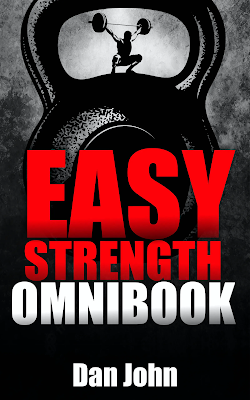
About a month ago, I had finished up another run of Jamie Lewis’ “Famine” training protocol and found myself in a situation wherein I had a pretty chaotic summer schedule ahead due to travel and family obligations, and could not, realistically, commit to a structured, rigid and involved training program like what “Feast” would entail.  So I needed to take on a new approach.  I had read the “Easy Strength Omnibook” over Christmas (reviewed on this blog. Spoilers: it’s amazing: read it!), and finally found myself in a position wherein I could run it…


Yeah that's pretty much me


…buuuut…I had JUST finished Famine.  I needed to do something that was going to make me GROW!  Easy Strength, in and of itself, was NOT going to accomplish that…which begged the question of what I would do for the “everything else” portion of the program in order to force some growth.  I, of course, instinctively dove toward Super Squats, and considered how it’d answer the “what do you do for squats on Easy Strength” question…but then it got me thinking about ANOTHER hard squatting program I hadn’t run yet…which was ALSO a Dan John program.  


Enter “Mass Made Simple”, a program that had LONG since been on my list of programs to run…but, in truth, I could not wrap my brain around the upper body portion of the program.  Having read through the book a few times, it seemed to violate the “simple” portion of “Mass Made Simple”, because it required a LOT of tracking, planning and tinkering…while “Easy Strength” actually seemed simple…


…LIGHT BULB!  Combine them!  Let Easy Strength take care of the strength and Mass Made Simple take care of the mass.  From reading Dan’s work and listening to his podcasts, the upper body training portion of MMS was really just boilerplate stuff that was thrown in to get in SOME upper body work, whereas the real “magic” of the program was in the complexes and the high rep squats.  That sounds JUST like the “whatever else” of Easy Strength.  Do the Easy Strength workout, and THEN do complexes and high rep squats for “whatever else”…the goal being hypertrophy vs athletic performance (the latter being the more typical goal/”whatever else” of Easy Strength).


With that, I had a way forward, and decided to be cute and call the whole thing “MESS”, standing for “Mass-Easy, Strength-Simple”, and fully capturing just what this adventure is. And after 20 Easy Strength workouts I’m halfway through Easy Strength, and after 9 Mass Made Simple workouts I’m over half-way through MMS, so I felt like laying down some observations NOW before too much time passes and I forget any of this.  And now I’ll have the intro knocked out when it’s time to do a full-up review.


That said, let’s bulletpoint this up and get some observations down.


---


"MESS" IN GENERAL


Props if you get this reference...and it would HAVE to be a PBJ to fit the program


* As far as making the schedule “work”, my situation forced me to get creative.  I don’t lift weights on weekends.  That’s my time with my family.  I will wake up before everyone on the weekdays to get in a lift, but on weekends I sleep in with the Mrs and spend time with the kiddo as much as I can.  This meant all my Easy Strength workouts were Mon-Fri, and I would have to find a way to get in 14 Mass Made Simple workouts in 6 weeks with that approach (Dan DOES permit one to stretch MMS out to 7 weeks, but that wasn’t something I was interested in doing).  In order to make the 14 MMS workouts fit, it required a schedule of effectively 2-3-2-3-2-2 MMS workouts over the corresponding weeks (2 on week 1, 3 on week 2, etc). 


* On the above, my preferred structure was to have MMS workouts be on Mon and Fri, with the 3rd one being Wed if applicable.  The reasoning for this was how my nutrition was structured, which I wrote about recently in my “nutritional alchemy” post, but, ultimately, on weekends I tend to eat more food than on weekdays.  So a Friday MMS workout meant I’d have the entire weekend to eat to recover from the training and force muscle to grow, and then I’d have my Rampage/carb up meal on Sunday and have that to train off of on Monday to really drive hard.  I’d go through my “fasting” meal on Monday, which had enough protein in it to recover and, combined with the HARD MMS workout, did a great job of causing some distress on my body to recover.


Like squatting 25lbs over bodyweight for 50 reps, for example


* The above schedule ALSO helps fit MMS’ intent of following up the hard squatting workouts with a “recharge” workout followed by a “rest” workout.  For me, these would be 20 minute hard conditioning workouts and long walks, while still including Jamie Lewis’ RX of 300 squats and 300 push ups daily.  I’d use the weekends to be generally physically active, but not engage in Easy Strength style workouts or anything that was stressful for long durations.


EASY STRENGTH IN GENERAL


Seriously: buy it.  It's Dan's Best work


* It’s EASY strength: it needs to be treated easy!  I’m a “grinder”, as Derek Poundstone would put it, and super mega slow-twitch, so I move 135 and 405 at the same speed.  But when the weights are easy, they should be moved fast and explosively.  Jim Wendler has spoken about this as well.  We get faster and more explosive by moving that way: grinding light weights just makes us even worse at moving light weights.


* That’s not to way that rep quality should be poor: the opposite.  Reps need to be owned.  This is an opportunity to master these movements, because the weight is light and we have a chance to really nail stuff.  My continental has grown in leaps and bounds because of the frequent practice and mastery.


* The parallels between Easy Strength and 5/3/1 become more and more apparent as I experience the program and review the lessons from Dan and Jim.  The difference is primarily that Jim is more prescriptive than Dan, which is funny because people comment on how Jim doesn’t spell out enough of the program, so they’ll REALLY dislike Easy Strength.  But, ultimately, the main work of 5/3/1 IS Easy Strength, especially when using 5s pro: it’s a small number of reps with light weight performed with the intent of owning the weight and crushing the rep.  From there, Jim lays out the “everything else” that Dan leaves up to the reader via prescribed supplemental, assistance, conditioning, jumps and throws.  Your “everything else” is hypertrophy?  Cool, do BBB or Building the Monolith.  It’s conditioning?  Great: prowler challenge.  Jim also spells out what weights to use, whereas Dan leaves it up to the trainee, and Jim forces you to use light weights whereas Dan tells you to do so.   So perhaps 5/3/1 is Easy Strength training wheels.


* Yes, there is a difference in that 5/3/1 doesn’t have you do the same movements everyday for 40 workouts, and instead tends to focus on 1-2 lifts a day, but that’s getting into nuance and preference.  One of the big takeaways here is how easily one can blend the methods as a result.  If you want to use Easy Strength AND build muscle without using my MESS approach, you could do Easy Strength and chase it with BBB, Monolith or Hardgainer supplemental/assistance/jumps throws and conditioning.  And hey: Easy Strength for Fat Loss is EXACTLY the “light conditioning” days of 5/3/1.


* In that regard, other places to steal for “everything else” would include the 10k swing challenge, Tactical Barbell (especially volume 2), Crossfit (do the Easy Strength program, then the WOD), Neversate/Brian Alsruhe programs (I’d skip Brian’s mainwork and just steal the assistance/conditioning to make this work) and, of course, Mass Made Simple.


Not really the go to for "Easy"


* Meanwhile, for contrasting programs to run AFTER Easy Strength is done, Dan’s 1 lift a day program is pretty much the total opposite of Easy Strength (focus on 1 lift a day, train that lift once a week, do it for a higher volume of total work), Deep Water (some lifts are trained once every 14 days, and you absolutely smash that lift), and possibly DoggCrapp (you’re rotating through so many movements that it’s a long while before you come back to it).  Conjugate would also strike a similar chord in that regard.


* The next time I run Easy Strength (which will most likely be very soon), I plan to use dips or incline bench vs overhead pressing for the press work.  I get in a good amount of overhead work with my conditioning, and with MESS it happens during the complexes as well, whereas my horizontal press these days is primarily the 300 push ups a day I do per Jamie Lewis’ mandate.  


* What I have found the most interesting thing about this is how my physique actually seems to be IMPROVING with Easy Strength, if not at least maintaining.  I felt like I would see a decline from the “lack of work”, but when you lift the same lifts 5 days a week, you DO get in a substantial amount of volume with high quality reps, vs a bunch of garbage sets.  


* Another theory I have about this is that I have “earned” this minimalist approach, as Dan writes about.  I had been going VERY hard and with lots of volume leading up to Easy Strength, and now this minimalist approach has allowed me to realize a lot of the potential I’ve been building up to as the fatigue dissipates and the body rebuilds.  Perhaps this also speaks to the “hormonal cascade” that Dan speaks of occurring once the lifting is done.


* On top of all of that, I can’t ignore how important my shift in nutrition has been as well.  I’m taking in SO much protein and quality fats these days and finally eliminated the ketojunk for good.


Keto...bread.  How was I this stupid?


* Short burstfire thoughts: Easy Strength works: I’m halfway through and already seeing results.  It IS easy, which is a good thing.  I dig these short workouts BECAUSE it allows me time to do other stuff.  In that regard, it’s good to cycle through the “whatever else” portion of Easy Strength and build other qualities.  Periodization, yet again.  Strength isn’t everything, and hypertrophy is a fine goal, so use Easy Strength to build your strength and use your “whatever else” to build your size.  That’s totally fine.


* A good approach to taking on Easy Strength at the start is to pick “new” movements to you so you can reap the benefits that come with improved mastery ALONGSIDE the benefits of Easy Strength as well.  You’ll observe rapid progression.  So go beltless if you’ve been using a belt, use chains or bands, go double overhand on your pulls, or use an axle, or use different foot/bar/hand placement, etc etc.


* Remember that a loaded carry is a LOADED carry.  If you just carry something: that’s a carry.  A loaded carry is a carry UNDER LOAD.  It took me a while to appreciate that.  It’s why I’m wearing weight vests and chains during most of mine.  Other alternatives are to pull a sled while you do it.  If you look at the cover of “Never Let Go”, you’ll see Dan really personifying this by carrying a sandbag while wearing a loaded backpack and pulling a sled.


Also a fantastic read


* For this particular run of Easy Strength, I kept it easy AND simple.  Dan said, if he could do it all over again, he’d just do 3x3, so that’s exactly what I did.  I also am keeping all the lifts the same throughout, minus the carries of course, since Dan said specifically to never repeat that workout.  The next time, though, I plan to play around with reps and sets and the movements as well.  Specifically, if I were to do another run like MESS or something similar with a hard lifting workout thrown in, I’d most likely make that particular Easy Strength day the 1x10 variant OR use the 1x10 variant for the follow-on day as a means to recover from the workout.  The 5-3-2 day would be a good realization day, and then 2x5 would be a good “punch the clock” sort of workout.  So, again, if this was MESS, you could do 5-3-2 on the MSS day, then do 2x5 as your recharge and 1x10 as your rest.


---


With that, there’s my halfway report.  I’m excited to see where this second half leads.


Friday, July 28, 2023

HERE COMES A NEW CHALLENGER

I miss arcades: they were such a pivotal part of my upbringing as a child of the 90s.  These days, they’re a dying medium, but in the 90s, there was nothing better than a real live arcade cabinet, let alone a whole bank of them all in one concentrated location.  If it was a Round Table Pizza, it was really like having arrived at the land of milk and honey.  And of all the many amazing arcade games out there, “Street Fighter II” will always hold high acclaim among those of us that “were there”.  Even if you owned the home version for the Super Nintendo, the arcade classic just blew it away with its superior graphics and sound.  BUT, what made the game a TRUE classic was that, at the arcade, you could get challenged by random people: not just family and friends.  Yes, these days you can accomplish that by being linked up with the entire world over your internet connection, but back in the day, if you wanted some fresh blood, you waited for some dude to plunk down next to you at the arcade cabinet, throw in their quarters, and be greeted by the phase “Here comes a new challenger!” flashing across the screen.  Suddenly, you knew: it was on.


It's honestly for the best, because this match has been done to death...and Ryu is still better


What if you just wanted to play the game on your own?  What if you just wanted to square off against the woefully inadequate (yet often cheaty) computer AI?  Sorry dude: you showed up to the arcade, you opened yourself up to these random challengers.  Your hard earned quarters just got taken from you as some pro came by and whooped you into oblivion.  Little did you realize just how awful of a choice Dhalsim was compared to Ryu.  Little did you realize WHY, despite looking so awesome, Blanka was a terrible decision.  But from it, you learned, and you grew, and perhaps you even started your very own revenge epic to come back one day and claim what was rightfully yours.


Ok, I’ve bombarded you with my nostalgia long enough, thank you for indulging me.  Why am I talking about this?  Because as you’ve most likely sussed out: this arcade experience is a microcosm for training (and life for that matter). So many of us are content to just play against that familiar computer AI with our absolute favorite character and just keep spamming the same Hadouken over and over again until we win…but do we grow from that?  NO!  What creates growth?  When that new challenger shows up!  Some rando that we’ve never played against before who comes up with combinations couldn’t possibly fathom and just absolutely wipes the floor with us and takes our quarters away.  And if we wanna beat them, we gotta plunk down some more change and get in a few more rounds to learn their strategies and come up with our own to overcome.


At the arcade, this was proverbial, but for Mike...


And much like our time at the arcade, there won’t always be a “new challenger” to force us to grow.  Sometimes, we WILL have to spend a few lonely hours just beating up the CPU.  But when the opportunity finally DOES present itself: we need to be ready FOR our new challenger.  There’s so much in those thoughts already.  We just re-described Dan John’s “Park bench-bus bench” principle, wherein the majority of our training time is going to be “punch the clock” workouts, but occasionally we really dig in and pour ourselves into our training.  Dan’s “Mass Made Simple” program is one that Dan himself says can be run “2x a year, tops”.  It’s only 6 weeks of training, and 14 workouts today.  So that’s 12 weeks and 28 workouts in a year where you’re facing “a new challenger”: the rest of the time playing against a CPU.  But also, let’s talk about “being READY for the new challenger”.  THIS is about taking on these protocols WHEN APPROPRAITE.  If your work schedule is exploding, your wife is in her third trimester, and you’re getting a masters degree, it’s probably NOT a great time to start up “Building the Monolith”.  But you’re a high school kid and it’s summer and mommy and daddy are footing the foodbill, why AREN’T you eating your face off and lifting like an inmate?


And what IS a new challenger in the world of training?  It’s something that FORCES us outside our comfort zone.  It’s something different.  We’ve already memorized the pattern of the CPU: the rando down at the arcade is entirely unpredictable, and we have to learn how to adapt.  In the world of physical transformation, this can be a training program that forces us outside of our comfort zone (hello Super Squats/Building the Monolith/Mass Made Simple/Deep Water), or it could be a nutritional protocol that runs opposite of everything we know (Feast, Famine and Ferocity/Carnivore/ABCDE diet/Velocity Diet).  And these are simply self-imposed “new challengers”.  Think about the obvious: ACTUAL challenges.  Signing up to compete in a powerlifting meet, strongman competition, bodybuilding show, crossfit comp, a marathon, a triathlon, etc etc: SOMETHING outside of your comfort zone that forces you to grow.  


Both men seen here outside their comfort zones


And rest assured: you WILL get your quarters stolen from you the first time you square off against that new challenger.  If it DOESN’T happen: you cherry-picked and didn’t gain ANYTHING from the experience.  You became that predator of the arcade looking to stomp newbs just go bolster your own ego.  We don’t grow from that.  Being king of Chuck E. Cheese is a title that no one wants.  “You are not a warrior: you are a beginner”, “Go home and be a family man”, and all the other fantastic taunts from such a legendary game are all too ready to employ here.  Instead, use these new challenger opportunities to realize your max potential and grow into something TRULY fearsome.  Make it so that when “Here comes a new challenger” flashes across the screen, you’re all too excited for it.  Finally: a challenge!


Thursday, July 20, 2023

YOU CAN’T OVERCOME A LACK OF EXPERIENCE WITH AN ABUNDANCE OF INFORMATION

I appreciate how the topic I’ve written for this post is just so straightforward, so I’m going to just keep on rolling with it.  This idea struck me this morning as I was finishing up my workout: a combination of Dan John’s Easy Strength AND his Mass Made Simple program (be on the lookout for a future write up there…alongside one called “Here Comes a New Challenger”, because my brain is absolutely schizophrenic along with obsessive and comes up with multiple ideas at once about the same subject all the time).  I had finished up the full workout and had 18 minutes remaining before I needed to get ready for work, so I decided to throw on the weighted vest and get in as far of a walk as I could in that time.  It was only at the end of that time that I remembered that I had intended to do a little bit more “bodybuilding” work after the workout: I was so…conditioned for conditioning (sorry, had to be done) post workout that I forgot my own plan (Chaos, of course).  So, upon my return to the garage, I quickly shucked off the vest and did 1 set of “Conan Curls” (band curls with the band around the wrists instead of held in the hand) and 1 set of full ROM lateral raises with 20lb dumbbells.  And that was “enough”…and in that I realized that I had learned QUITE a bit in 23 years of lifting weights regarding how to get as much as I could out of a single set…and, in turn, realized just how LONG it took me to accomplish that.  Because it doesn’t how much you academically “know” about training: without the necessary experience to actually IMPLEMENT it, it’s all just theory.


No, seriously: what's a widget? 


What’s funny is that this is something we know about any other physical activity on earth, but for some reason people treat physical transformation as a separate physical entity.  If I tell you that you can’t READ yourself into playing the piano, or shooting a freethrow, or swimming, you’ll go “duh!”  I suppose combat sports runs into this too, because I’ve known cats that thought they could teach themselves to fight from reading, but, at the same time, martial arts are so mired in mythos (“My Uncle TOTALLY learned from a Shaolin monk a pressure point that will KILL you with just 4lbs of pressure!”), but you get my point.  When it comes to acquisition of physical skills, we understand that they are just that: SKILLs.  NOT knowledge.  Yet the very Role-Play-Game-Playing nerds that can appreciate just that idea (in the “White Wolf” series there is literally a breakdown of “talents, skills and knowledge” for your character sheet!) are the same ones that rally AGAINST it when it comes time to actually put pen to paper…man these puns.  “I already KNOW how to maximize the lateral raise: I gotta keep my chin tight, not shrug my shoulders, control the weight, pinky down, chest high, brace, ground my heels, but I STILL only feel it in my traps”.  Dude: it’s because even though your brain might be smart on all this stuff, your body is stupid.  It needs more education, and that comes PURELY from experience.


No matter how much you read ABOUT the lateral raise, until you have a few hundred thousand reps under your belt, you’re going to need to PHYSICALLY learn how to do the movement.  That’s why cues are so popular in the first place: they’re little mental reminders on how to move PHYSICALLY.  BUT, if you haven’t ever “gotten in” when it comes to the movement, the cue is an answer seeking a question.  You don’t even know what “right” feels like to know if you’re GETTING there yet, and it just takes a LOT of practice to get there.  Again: this is obvious with any OTHER physical skill, primarily because we tend to get instant feedback.  Did the ball make it in the hoop?  Congrats: THAT’S how a free throw feels.  Did you NOT drown?  Congrats: you swam!  Knock down all 10 pins?  That’s a strike!  But how do we know when the lateral raise was done right?  When we finally have some goddamn lateral deltoids to show for!  And that takes TIME…BUT, at the same time, an experienced trainee can ALSO “know” when they’ve gotten it “right” because they’ve eventually gotten it right for so long that they “KNOW” the feel that they need to achieve in order to accomplish their goals…which just results in even MORE confusion for the junior trainee observing the experienced.


There is a reason this meme exists


How many times have you seen the critique that “so and so can do XYZ BECAUSE they’re a pro!”  Hell there Branch Warren/Johnnie Jackson/Ronnie Coleman/Arnold/etc.  It’s this idea that, somehow, these pros are “training wrong” because how they train doesn’t LOOK like textbook technique.  But winding it back to the combat sports reference: how many times have you seen an accomplished professional boxer with their HANDS DOWN?  Isn’t “hands up” that thing your boxing coach is CONSTANTLY shouting at you?  How come the pros have their hands down?  Don’t they know better?  They most certainly do: they know WHEN to keep their hands up, primarily because, after DECADES of experience, their sense of their opponent’s timing and range is so well tuned that they KNOW when they are actually in danger and NEED to have their hands up to defend and, in turn, they know when they can relax and SAVE their energy, rather than fatiguing their shoulders from constantly being “on guard”.


It’s no different from the experienced lifted that is seeking to achieve physical transformation: they don’t NEED to do all that “other stuff” to accomplish their goals: they are beyond the point of cues and can simply replicate the feel that they need to feel in order to achieve the goal they are seeking to achieve.  From there, they tend to develop their own unique style and approach to the situation that best suits them on an individual level, because they have MASTERED their bodies THROUGH experience: NOT through academia.  THIS is the value of physical experience: it can NOT be replicated through speech or text.  And yes, I fully appreciate the irony of me writing about this very subject in order to impart upon you the knowledge that knowledge in and of itself is not enough, but in turn maybe we can appreciate where knowledge IS valuable: in the sharing of ideas, concepts, notions and experiences in order for the reader to TRY IT and GAIN the necessary experience that comes from it.  It’s why I’m such a fan of story-tellers over researchers: SHARE with me a story, tell me a tale, let me learn FROM your experience so I can try to have experiences of my own.  As a parent, THIS is the valuable lesson you impart upon your own children.  They can learn facts from school, or books, or the internet (god forbid), but YOU get to share with them your experiences. 


In fairness, there's a lot of trainees that could stand to learn this lesson


And, much like junior trainees: most kids will ignore you because they can only REALL learn from the school of hard knocks…but at least, once they DO learn, they come back and say “oh wow….you were RIGHT!” 

Thursday, July 13, 2023

WHO IS ON YOUR MIXTAPE?

Already the topic title is showing my age, and for some of my readers I’m going to need to explain what a “mixtape” actually is, so let me get that out of the way.  Back before everything was streaming, physical media was the only real way to enjoy electronic entertainment, outside of just plain old listening to the radio (which, oh man, doesn’t THAT sound ancient).  In the CD era, it was common for someone to have a large library of music from CDs from various artists and, before engaging on a long road trip, or as a gift to someone with a mutual interest, or simply “just because”, they’d create a “mixtape” (yes, tape would refer to the era of cassettes, but just stick with me here) of various songs from various artists.  Sometimes, these would be themed (a “Valentine’s” mixtape of love songs, or a “Hardcore Metal” mixtape of various hard hitters), and sometimes it would just be absolute madness of stuff mixed up, but the end was the same: different songs from different artists all on one CD.  Heck, you can even buy these NOW, ready made for you at your local Walmart, typically in the form of “Now That’s What I Call Music Volume Infinity”. But what was interesting about these mixtapes was more about what they revealed about the CREATOR of the tape.  Specially, what sort of musical interest they held, what artists they had been exposed to, and, quite simply, what they considered to be “good music”.  So tell me, dear reader: who is on YOUR mixtape?


Like this, but for music...and yes, I DID had this demo disc


This whole idea came to me in the shower this morning, as most good thoughts do, as I was recovering from my current workout of Dan John’s “Easy Strength” AND “Mass Made Simple” mashed together (which I intend to flesh out more fully in the future, as it’s just plain awesome).  I started thinking how fortunate it was that I stumbled across Dan John, and it was because I was so fortunate to start reading about training from a martial arts background rather than a meathead/bodybuilding one, which meant I got turned on the Pavel Tsastouline right from the get-go alongside Super Squats (both recommended to me by the same dude, which I owe a LOT for having done so), which got me pointed in the direction of Ironmind, which got me pointed at Paul Kelso and John McCallum while at the same time also got me heading to T-Nation, which got me pointed at Dan John’s book “Never Let Go”, which I DIDN’T let go of from start to finish (reading it on a cruise on an old school kindle when I should have been…enjoying the cruise).  And somewhere along the line I got pointed in the direction of the delightful lunatic of Jamie Lewis, of which I’ve written extensively of his benefit to my overall life, and how interestingly that matched up with Dan John’s high praise of “the Velocity Diet”, and how through T-nation I discovered Date Tate, which got me to Elitefts, which totally colored how I approached training and nutrition in my 20s, which got me pointed to Jim Wendler for 5/3/1 AND Mark Bell for “Power Magazine”, through which I RE-discovered Jon Andersen (“that jacked dude that competed in IFSA?  Hell yeah!), and there’s still SO much more in there I’m missing (Stuart McRobert, we love you!...some of the time!)   Man, what a wild journey: thanks for engaging me there.


But check out MY mixtape up there: what an eclectic collection of interesting lunatics.  But that’s also the key point there: almost all of those folks I listed are INTERESTING.  Many were trained WRITERS rather than lifters (Paul Kelso, Dan John, John McCallum and yes, even Jim Wendler’s degree was in English literature and Jamie Lewis’ academic background was on history), and those that weren’t trained authors were, legit, just absolutely insane (Jon Andersen was functionally illiterate and Mark Bell/Dave Tate BOTH overcome learning disabilities).  I was simply never drawn to those authors that were more academic, researched and scientific than they were talented storytellers.  I suppose it boiled down to, if I was going to spend time reading, I wanted to be entertained, since this was my “free time”.  But, as a result: isn’t my OWN training and nutrition pretty entertaining?  This is, of course, self-validating: I’m asking an audience of people that came here to READ me if I’m entertaining…but the sheer fact this blog has ANY sort of following means at least SOMEONE finds me entertaining (and hey, I’m in YOUR mixtape: inception!).


Really going the the early 2000s stuff today it seems


But SOME of you dudes out there are only listening to the top 40s!  Some of you dudes out there are PURE “bubblegum pop”, only listening to what’s popular, mainly because that’s “safe”.  You’re so afraid of having an actual opinion or feeling about the music that you let “the industry” tell you what to like and what not to like.  Alternatively, some of you stopped listening to new music once high school ended, and you’re that dude that just had to keep changing their radio station from “pop” to “modern” to “retro” to “classic” to “oldies”, trying DESPERATELY to hunt down SOMEONE who will play “Smells Like Teen Spirit” over the airwaves for you! (Sirius XM has you covered by the way).  Some of you have a mixed tape of 1-hit wonders: dudes that were right ONE TIME and could never recapture that magic, and you just keep going back to that well to relive that one moment even though their time is GONE. 


Flat out: I don’t wanna go on a road trip with some of you dudes, because your mixtape is BORING.  It’s awful.  It’s all stuff I’ve heard before.  Where are the DEEP TRACKS?  Where’s the stuff I haven’t heard before?  Where is the new, undiscovered artist?  Where are those artists who take risks?  Who try something new, different, that hasn’t been heard before?  Play THAT music for me.  Force me out of my comfort zone and let me see if I care for it.  And FORCE me to sit down and REALLY listen.  Did this artist achieve their goal of making ART, or did they achieve their REAL goal of making money?  Hell, I like ACDC, but what I really like about them is that after I bought one of their CDs I effectively owned their whole collection.  Meanwhile, Trent Reznor can release a CD where he sounds like a different artist THROUGH the CD, and for some of you cats he’s too “mainstream”.  And meanwhile, no matter how much I try to like Amon Aramath, since “Viking” and “metal” sound like they’d be great together, I can’t get over how much the lead singer sounds like Cookie Monster….but at least I listened to a LOT of their music before I came to that conclusion.


At least these guys knew they were a parody


A common phrase is “you are an average of the 5 people you spend the most time with”, and there’s a lot of value in that phrase, but it, of course, extends beyond just your friends and co-workers.  Your training and nutrition is going to be an average of the 5 individuals whose media you consume.  I had to re-write that line a few times, because I originally wrote “authors” until I realized that SO many of you dudes AREN’T F**KING READING!  …of course, I’m saying that ON my written blog, so most likely you AREN’T the machine I should be raging against (music pun: hah!) but ya’ll get my point: some folks ONLY consume social media for their information source on how to achieve physical transformation.  Folks: I read entertaining authors, but I was READING AUTHORS: it was 200-300 pages of information.  No matter how entertaining you try to be, over the course of 200-300 pages, you EVENTUALLY say something valuable (although I still think “The Sun Also Rises” was awful…).  But social media stars?  They pride themselves on stretching out how long they can get you to watch their videos and do so by padding the hell out of them with garbage and click bait so you hang out JUST long enough to hit whatever metric they need to hit to cash in.  And it costs them NOTHING to throw up a video, whereas a published author had to go through the rigors of actually having their work reviewed by SOMEONE ELSE that saw fit to publish it (not counting e-book trash directly flooded onto the market…as someone that release a free e-book with no publisher whatsoever).  Yes yes, if you wanna take this music metaphor further you could very well claim these are “undiscovered artists” and that publishers are just “the industry” dictating what is and is not popular: if you’re intelligent enough to be able to figure that out, maybe you can sort the wheat from the chaff when it comes to these internet fellows.


But either way, take a step back and look at how is on YOUR mixtape.  Is it a mixtape you’d be ok sharing with someone else?  Or is your musical taste…a little embarrassing?  Would you throw your mixtape into the CD player on the roadtrip and let 3 other people jam to it?  If someone wanted a changeup, would you say “give THIS a listen!”?  If not: why not go pick up some new tunes somewhere and see where they take you?  Head down to Sam Goody (points if you know what THAT is), pick up a bunch of CDs from dudes you’ve never heard of before, given them a listen and see what jumps out.  Even if nothing grabs you right away, occasionally, and ear worm works its way in and you eventually think “hey, that was actually pretty good: I wonder what else they released?”

Friday, July 7, 2023

THE FREEDOM OF LIMITATION

I know I’ve written about this multiple times, but I’m observing this phenomenon outside of the realm of lifting so much that it’s sticking inside my head.  I’ve recently become addicted to “Erik the Electric” videos on youtube which, if you’re unfamiliar with Erik, are videos of a 5’9 160ish ultra endurance athlete tackling massive food challenges.  I already feel a kinship with Erik being of equal height, he is a San Diego native, much like myself, I’m (sadly) around his weight as well, I enjoy eating prodigious amounts of food as well, and my heart is one of an ultra endurance athlete, but Erik is also addicting just because he actually ENJOYS the food he eats in the challenges vs the horror one observes at the Nathan’s Hot Dog Eating competition wherein competitors are effectively choking down food to meet the goal.  But weird competitive eating tangent aside, Erik is so talented at his “craft” that he often goes out of his way to impose challenges WITHIN already absurd challenges, because the initial wasn’t challenging enough.  He’ll take on the infamous “octuplet bypass cheeseburger” from the Las Vegas Heart Attack Grill (yes non-US readers: all of that is really a thing) and then make it more challenging by eating a SECOND one AND only allow himself an hour to accomplish it.  These are no one’s rules but his own: a self-imposed challenge and limitation. And quite often, Erik will meet the ACTUAL challenge just fine, but fail to meet his own self-imposed challenge, and hold himself as a “failure” for having done so.  My friends, there is so much to learn from this black hole given human form.


If my subconscious could be photographed, it'd look like this


First of all, it’s worth observing that, again: Erik is not unique in this style of competitiveness.  We can observe this with video game speedrunners as well: people so good at games that they race to see who can beat them the fastest.  Eventually, they all learn the same tricks and strategies to maximize win speed, so they move on to FURTHER handicap themselves, with rules like “no moving left” or “without glitches”.  We’ve seen combat sports athletes that will only use 1 or 2 techniques to win a match.  The list is extensive, but the point to observe is that these folks are so GOOD at what they do that they need to impose limits on themselves “just to keep it interesting”.  But in keeping things interesting, they keep themselves sharp as well: they force themselves OUT of their own comfort zones and give the opposition a leg-up.  Growth is an outcome of overcoming, and in order to overcome one must experience adversity, and in the ABSENCE of the necessary adversity to promote growth, one is challenged to CREATE the very challenge necessary TO grow.  The challenge is to challenge: how fitting!


Let’s take a few lessons out of there.  1: no matter the situation, we can find a way to make it worse.  That almost sounds sarcastic, but here: it’s liberating!  This was a lesson many of us learned during COVID.  Resources were limited, and soon it became a competition on HOW we could make things more challenging.  Dan John (shocker) is a master at just this: give him 1 kettlebell and he’ll find a movement that puts you in such a poor position that this KB, irrespective of weight, will force you to grow.  Many people were limited to just bodyweight, so they had to learn all the tips and tricks OF bodyweight work to maximize it, finding ways to maximally disadvantage the body.  Some had SOME weights, but very limited amounts, and minimal ability to obtain more…so out came the pre-exhaust work, dropsets, stripsets, rest pause sets, etc etc.  And HERE there WAS a forreal limitation placed upon us: the world of COVID forced many away from their training spaces and stole their equipment.  Absent that FORCED limitation, we can still create our own.


Limitations in other ways I suppose


Along with that, though, consider the necessary degree of creativity that must be there when we CREATE these challenges AND formulate the execution plan to accomplish the goals.  First, there is a necessary element of creativity in creating a challenge: as the word “create” is right there.  We must be able to think and act in an inventive manner in order to invent a challenge for us to overcome, and if we lack said creativity the very repetition of attempting to create these challenges will drive us.   There’s no shame in employing dice or a spinning wheel or a random number generator to determine your fate.  Consider the mental bandwidth that gets relieved when one outsources their own creativity externally.  But, alongside that, there comes the creativity necessary once the challenge is underway!  If mere conventional manners of approach were enough to overcome the challenge, It would be no challenge at all: it would be the status quo.  Instead, because we created a unique challenge, we need to create a unique plan of execution.


You can again observe this with the elites like Erik.  If they give themselves an hour to eat a 5lb cheeseburger and order of onion rings, you’ll see them attack the food in an unconventional manner, eating the protein first and saving the carbs for last, since they are the most filling, for example.  There is an exponentially effect of creativity: creating the challenge forces us to create the solution.  But I’d say one of the biggest boons here is that we are no longer shackled by the chains of “optimal” once the challenge has been issued: we’ve now simply climbed into the realm of “survive”.  And through surviving we grow, and through growing we achieve.  By artificially hamstringing ourselves, we put ourselves intentionally off-balance and can now only simply maximize from our current position rather than from the most ideal position, which is to say that there now is no longer “THE” right way to do things: simply A right way to do things.  Once again: THAT is freedom.  When success has many avenues, you are in an ideal state.  When there is only one path, if you miss it: it’s game over.  Going back to the speedrunners: if they miss one jump in Super Mario on one particular stage, they’ll just quit and start over.  It’s known what needs to get done to reach “optimal”, and if it’s missed: it’s over.  But if playing the game with your feet?  Who KNOWS what the optimal time or strategy is for that: let’s just see if we can do it first!


Oh my god it all makes sense now


There are so many lessons to be learned from all of this, but what I want to impose on those reading is that this can happen TODAY.  We can place a limitation on ourselves and use it NOT as a limitation but as a vector.  As a “freedom granter”.  In a world with an abundance of choices, we can suffocate from too much freedom, but we, in turn, have the freedom to DETERMINE our limitations.  Much like “the myth of Sisyphus”, we can CHOOSE a less than desirable fate and, in doing so, be liberated.  I’ve been most likely boring many of my readers with how big a fan I’ve become of the carnivore approach to nutrition, but it’s because of this very freeing limitation that I enjoy it so much.  I thrive with restrictions and flounder with freedom, and for so long I employed the restriction of “low carbohydrate” that I became TOO GOOD at it, and was, in turn, consuming all manner of keto junk food, treats, tricks and hacks while still abiding by my own rules.  By making the game harder and saying “animal only”, I’ve once again placed myself in a corner and have to use creativity to solve it.  It is liberating: I no longer need to think about WHAT I am going to eat: it’s an animal of some variety.  I’m following Easy Strength right now, and therein is a program where the limitations are hard set: 40 workouts, 3-5 exercises, 3-5 days a week, no more than 10 reps, never miss a rep.  The program is SUCH a breath of fresh air if you’ve been suffocating on percentages and RPEs.


Take this homework assignment and run it to completion.  Give yourself some limits and see what you come up with.  Imagine if you said you could only use a rack and barbell, like the York lifters did back in the day.  The precious bench press is gone: however will you survive?  Probably by building a set of shoulders so massive and dense that they draw all surrounding light into themselves and actually prevent humans from being able to observe your pectorals.  You can only do squats AFTER 10x40 yard prowler runs: better get fit if you wanna get jacked!  Try a month of eating BELOW recommended protein intake and see how the REST of the world somehow manages to put on muscle DESPITE inadequate protein intake.  Use intermittent fasting during a gaining phase and learn how to get in 4000 calories in a 6 hour window.  Come up with your own, try it for a training cycle and see what the impacts are.  You don’t need to wait for an injury to train like you’re injured, you don’t need to wait for a food shortage to train like there is a famine, you don’t need to develop allergies to cut wheat out of your diet: these are all opportunities to learn, grow, challenge yourself, overcome and, through it all, improve your creativity so that, when the time comes, you have THAT skill readily developed and deployable.  


Tell me more stories Uncle Pavel


And you will be free.  There will be no right choice: just the choice that’s right at that moment.    


Friday, June 30, 2023

MY JAMIE LEWIS EXPERIENCE PART 2: "FEAST, FAMINE AND FEROCITY" AND THE RESULTS

 Readers, part 1 of this got released a while back, so for a refresher, be sure to re-visit here

https://mythicalstrength.blogspot.com/2023/05/my-jamie-lewis-experience-part-1-apex.html

Now onto part 2!

---

CHANGE 2: “FEAST, FAMINE AND FEROCITY”

I had no idea when I bought this that it was literally going to change my life. I now get chills seeing it.


It was practically kismet when Jamie released the Feast, Famine and Ferocity e-book, itself a re-packaging and update of an article series he’s previously released on his website.  I’ll do a review of the book package itself sometime in the future, but a quick summary is it’s a 50 page e-book where half of it is dedicated to the aforementioned program series of “Famine” and “Feast” while the other half is a republishing of his Bruce Randall article.  The later article IS a fantastic read, and I’d read it many times beforehand, but it’s worth appreciating that it’s really more a 30 page e-book in this regard.  That said, much like I wrote about in my review of Ben Pollack’s “Think Big”, a short e-book where every page is gold is SO much more valuable than 300 pages of fluff, and Jamie’s book definitely achieves that standard.


I genuinely had no intention of changing programs when I bought the book: I just am such a fan of Jamie that when he sells stuff I buy it so I can give him support.  However, upon reading it, I new my fate was sealed, similarly to the first time I read “Super Squats” and was all keyed up to begin my 6 weeks on that program once the book was done.  The primary draw was the fact that the “Famine” diet was VERY similar to the Apex Predator modification I was currently following.  The primary difference is that Famine has NO solid meals whatsoever: all shakes.  I wasn’t about to do THAT, but I did permit myself a few “all shakes” days in the 2 weeks that I followed the program, primarily because my schedule would permit for that…which meant, specifically, my wife would be out of town and I wouldn’t be missing any meals with her.  If she’s around, I’m not going to skip a meal with her to have a shake.  Sorry: priorities.


Seriously: don't be this person


I’ll then go on to say that, when I finished the entire book, I thought “Yeah, Famine fits, but this diet has been going so well that I’m not gonna do ‘Feast’.  I’ll do Famine and then something else”.


Yeah: that fell quickly to the wayside.  Jamie’s programming was so solid that I couldn’t wait to see it all the way through.  So with that, allow me to discuss both programs in a broad scale before going on to discuss each in detail.


THE PROGRAMS IN GENERAL


"Chaos is the plan: the plan"


I’m drawn to Jamie’s programming primarily because he doesn’t rely much on percentages and he encourages experimentation.  His programming is far more ideas and structures than an actual set routine, and the focus is on effort.  What was even more awesome about both Feast and Famine was that Jamie offers a 3-4 day variant and a 5-6 day variant of both programs, so there’s a LOT of flexibility there.  Those 3-4 day variants are LOADED to make it all work out, so, amazingly, I found myself drawn to the 5-6 day variants instead.  Since I get up early to train, I’m able to train 5 days a week without issue and didn’t need to cut down to 3-4 days, despite the fact I’ve written about the value of lifting weights 3-4 days a week to put on size.  It helps that, at this point in my training, putting on size wasn’t the concern: I had Super Squats for that.  For now, the goal was simply to experience the training and see what happened.


**AWESOME ELEMENTS OF FAMINE AND FEAST PROGRAMS**


Because combining 2 awesome things can often result in exponential awesomeness rather than linear


* Both programs feature a day Jamie refers to as “Dealer’s Choice”, which is as it sounds: do what you want.  For Famine, it’s up to 90 minutes.  For Feast, there’s no set time and Jamie even permits you to make it a day off if needed (which, despite all the increased cals, you may still need: I’ll detail that more later).  Either way is brilliant, and I think EVERY program needs this.  Trainees are stupid.  I’m including myself in there.  Trainees will ALWAYS sneak stupid crap into a program.  Pet lifts (curls, of course), stupid human tricks and gimmicks, “weak areas”, etc.   Trainees will inevitably wreck a program because they’ll change it up too much to fit in all this extra stuff that they end up reducing the effectiveness or flat our violating the intent, turning accumulation into intensification or GPP.  By having ONE day of the program where you just do what you want, you can get it all out of your system and then get back on program.  It’s the “cheat meal” of training.  During Famine, I’d throw in ALL that extra stuff I was doing before: Poundstone curls, lateral raise deathsets, belt squats, Kroc Rows, mat pull ROM progression, etc.  During Feast, my schedule was nuttier, so I often would just continue the ROM progression cycle and, if I had time, throw in some conditioning work and call it good.  But in both cases: my program compliance was MUCH stronger compared to programs I’d run in the past.


* Daily physical requirements/daily work.  Prior to starting up the program, I had my own daily work, which was: 50 chins, 50 dips, 50 pull aparts, 40 reverse hypers, 30 GHRs, 20 standing ab wheels, and often some neck work.  I’d get this done no matter what.  Jamie prescribes a daily 2 mile walk, outside, no matter what, along with 300 squats and 300 push ups.  I balked when I first saw that…and, in turn, loved that I had a new challenge in front of me.  And yeah: the first 2 days, I was SORE AS HELL, but upon adapting, I saw some AMAZING results.  The push ups and squats have honestly been transformative, as I’m seeing veins all over my quads and shoulders, but honestly, that daily 2 mile walk outside has probably been one of the most positive things I’ve ever done for myself.  It’s a chance to clear my head, get in some vitamin D, and bring back some health into my life.  Having it be a daily requirement and forcing myself to come up with ways to fit the walk into my day has been awesome, and my dog is appreciating all the time outside as well, and it’s gotten me to break out my weight vest again to add in even more resistance opportunities.  And that 2 mile walk has become a mere minimum, as I find myself becoming “activity seeking”, and will often get in 2 miles unweighted walking and then an extra 1-2 miles with a weight vest on as well. 


* On the daily work, Jamie is adamant that “this is not part of your workout-it is part of being a human being”.  I appreciate the sentiment there.  Being able to move your body through space is huge.  That said, I was big on making the push ups and squats INTO a workout when possible.  Toward the end, my go to was to use Tabata intervals of 20 seconds on/10 seconds off and do squats during the 20 second and push ups during the 10.  I’d settle on 20 squats per round and 15 push ups, getting me 300 squats in 15 rounds, and then I’d do the remaining push ups as fast as possible.  Keeping to those Tabata intervals makes this a pretty solid conditioning hit and only takes about 9 minutes to knock out.  Typically, I’d do this after the workout on weekdays, and on weekends I took to accomplishing it literally as soon as my feet would hit the floor in the morning.  I HATE working out, still do, and getting this done ASAP was pretty big for me.  Sometimes, though, I’d get cute and start incorporating push ups and squats into a larger conditioning paradigm, like in a circuit with swings, or GHRs, or chins, etc.  But, either way, I always met these goals.


**DEVIATIONS I MADE TO BOTH PROGRAMS**


Yeah, none of this with Jamie


* Jamie encourages experimentation, so game on.


* Jamie slots that “Dealer’s choice” toward the middle of the week with both programs, but for my work schedule it worked better to put it on Fridays/Weekends.  In the case of Famine, his middle of the week workout is either a day off or a 30 minute bodyweight conditioning circuit, which fit MUCH better with my weekend schedule, so putting that on Sat/Sun and Dealer’s choice on Friday allowed me to get in a 60+ minute dealer’s choice workout, which got in a lot of work.  In the case of Feast, there are 5 loaded days of training that worked much better for M-F for me, and then dealer’s choice on weekends allowed me to get anywhere from a 4-60 minute workout, depending on what my choice was as the dealer.  


* I made sure to run a full week of both programs exactly as written out, to include rest times, exercise order, etc.  In doing so, many of my workouts ran into the 80+ minute mark, which became a bit cumbersome with my schedule, but I wanted to understand how the training “felt” before I mucked with it.  Once I had that baseline established, I broke out the giant sets, short rest times, etc: all those tricks I’ve used in the past to get in more volume in less time.  I still made sure to bring the intensity, but wherever I could find logical pairings and groupings, I’d throw them in.  The 5xAMRAP hanging leg raises that happen EVERY training day are a quick kill, and much of the arm work could work in with other stuff.  Sometimes, though, it’d become something incredibly brutal, like bouncing between heavy shrugs and squats during Feast (more on that later).


* You’ll note I did NOT write about additional conditioning work, extra workouts, etc etc.  Jamie really “fixed” my compulsion here.  I’d be done with the training…and I’d trained “enough”.  This was really pretty huge for me.


*”FAMINE” SPECIFIC OBSERVATIONS/DEVIATIONS*


In case you need supplemental reading

* With Jamie’s permission, I took full workout footage of all my training sessions of Famine AND Feast, so I’ll post those if you want to see the whole thing in action.


* I made a few deviations from the programming, more out of equipment limitations.  I don’t have a leg extension or leg curl machine.  For extensions, I could use my reverse hyper, sit on top of it, hook my feet through the straps and do extensions.  That worked well.  Turning around to do curls that way?  Not as great.   I stuck with it through Famine, since it’s only 2 weeks, before eventually just going with GHRs during Feast, and when I return to Famine, that’s where I’ll go.

* My cable set up is pretty janky, so for cable rows I went with landmine t-bar rows instead.  I also don’t have a machine shoulder press, but I rigged up a VERY awesome Viking press set-up with bands that was clutch (you’ll see it on the video).

* Strongman implements regularly featured, because they’re awesome.  I also was making extensive use of the SSB, because I was still pretty broken from Super Squats.

* I didn’t follow the diet 100%, but I met the spirit of it.  LOTS of caffeine, shakes made up the majority of my nutrition, calories were low.  I trained fasted as well.  

*”FEAST” SPECIFIC OBSERVATIONS/DEVIATIONS*


This photo needs a trigger warning for excellence


* Here’s the “FEAST” playlist


https://www.youtube.com/playlist?list=PLfcuGAffLlSf-y7VAbGZ3TVKoE1T5OycC


* I underwent a MAJOR nutritional pivot during Feast, and it’s been one of the most positive things I’ve done for myself in a long time.  I absolutely didn’t meet Jamie’s prescription as far as calories goes, primarily because I’m not going to count calories.  In addition, the shakes were still regular features because they went a long way toward streamlining my life.  HOWEVER, for my solid meals: I went carnivore.  I’d been wanting to try out a carnivore diet for a few years now, after listening first to Shawn Baker and then Paul Saladino and a few other carnivore influencers talk to the approach (and constantly hearing Mark Bell beat the drum for it).  This also matches up a bit more directly with how Jamie laid out the “Apex Predator Diet”, as the solid meals were all meat.  I honestly just wasn’t in a good place psychologically to undertake it, but this protocol was VERY freeing in that regard, so I went full steam ahead…and it’s been amazing.  I’ll probably just have to make it another blog post (a continuation of the overhaul series), but I’m only eating meat, eggs and cheese/dairy, and I attribute that to some of the AMAZING results I’ve gotten (will sum that up at the end).  I still opt for high quality sources (grassfed beef/dairy when possible, pasture raise eggs, etc), and I’m still using supplements to fill in gaps (Superfood, Flameout, several others), but the Feast has been a carnivore Feast.  Conan approved!  


* After the first week of Anderson squats, I used a larger ROM and started using bands.  That was the right call.  My hip and knee were STILL messed up from Super Squats, and heavy loading was killing them.  The bands allowed me to keep the bar weight low, but the intensity was THROUGH THE ROOF.  Try breaking a dead weight off of chains when it’s banded in place.  It takes EFFORT!  And you can NOT quit once you start. 


* Rather than do 5x10-15 leg curls, I did GHRs.  But along with that, I did them with my push ups and squats, turning it into a circuit workout.  I worked up to a final workout of 15 rounds of 15 GHRs, 20 squats, 15 push ups, then got in the remaining 75 push ups to get my 300, then went for a max set of GHRs.  It was a LOT of GHRs. 


* For benching, week 1 was dead bench, week 2 was dead bench against bands, week 3 was touch and go axle bench, week 4 was pause axle bench with chains.  I ultimately just needed gimmicks to get me through it, but I was getting stronger.


Me and gimmicks?  No way!


* For pressing, I set out with a goal to get all 8 sets done in 8 minutes, using an EMOM style, so I never increased the weight on it.  Different ways to progress.


* For the squats and shrugs day, I rotated between SSB front squats and SSB squats, primarily because, with a deathset at the end, it was good to use the SSB.  SSB front squats are honestly a hidden gem of a movement that I rediscovered, and I’ll need to include it more in the future.  For the shrugs, I did my best to set it up like a hip and thigh lift, but on one set in particularly I REALLY crunched my left quad and had to eventually settle on trap bar shrugs for the final week.  And I think that’s going to be a more permanent solution.  It just works better.


* On that same day, instead of the leg curl work, I would do GHRs while holding a kettlebell in a goblet squat position.  Honestly: this is an AMAZING hamstring workout.  I made my final one particularly tough by doing sets of 3 every 20 seconds, getting in 9 sets total, then the 2 AMRAPS, then dying.


* For pulls, I did a whole bunch of crazy crap, but it always included the trap bar.  High handle one week, ox lift one week (torqued my knee and wanted to keep loading light on the knee), high handle again but with short rests, low handle.  I stuck with trap bar because my “Dealer’s Choice” was deadlift bar ROM pull progression (I started the cycle on Famine and continued it through Feast, which was like a billion IQ move on my part) and I didn’t need to pull heavy with a strap bar twice in a week.  This also made the rows awesome, as I went with trap bar rows, which are what I’ll bring into Famine.  They’re an awesome movement.


**RESULTS**


Christ I'm old to be referencing this...


* It’s so rare I do photos, so appreciate this.  This isn’t 6 weeks purely on FFF, but the end of Super Squats and the final week of “Feast”, so about 9 weeks of change. 


* As far as lift results go, I genuinely hate detailing this stuff, since my training is so wild and difficult to track.  I’m gonna just shotgun some stuff here, but ultimately: I’m the strongest I’ve been in a LONG time while also the leanest.


> From week 1 to week 4 of Feast, I went from only being able to do 3 rounds of EMOM 200lb log clean and press for doubles to getting through a full 8 rounds of it.

> From 4 triples of SSB squats w/405 in the first week of Famine to 6 triples of 415 in the third week of Feast

> 4x2x321 axle bench in the first week of Famine, 10x2x301 in week 3 of Feast (with 1 minute rests vs 2+)


* But honestly, stuff like this 


is really what I find most impressive as far as results.  That’s an 11+4+3x405+chain mat pull, but the context is: I had been walking around the zoo for 6 hours that day, having only had a Metabolic Drive shake for lunch and then coming home from a solid [carnivore feast https://global.discourse-cdn.com/tnation/original/4X/e/1/d/e1d5ffdf73834fc67487531f81d2d921476cc598.jpeg), and I had 5 minutes before we were going to turn right around and walk the dog (get in my 2 miles).  I threw on some shorts I had on the laundry, warmed up with ONE rep of 155+chains, and then pulled that.  All the daily activity, new stuff I’ve been exposed to, good eating, etc etc has me fully healed and ready to move and act when needed.  I’ve genuinely just never felt more capable and dangerous.


**CONCLUSION**


And now I'm even older to reference this...


* Folks, I could legit talk about this protocol any Jamie’s intervention into my life for a LONG time.  It’s honestly hard to cut myself off here (my current write up is 10 pages in length, but I’m trying to chop it down to make it readable for you).  Please ask questions, but, in general: this has become my favorite protocol in 23 years of training.  Everyone needs to run it.  Everyone needs to try Apex Predator.  Everyone needs to buy stuff from Jamie.  Call me a shill: I don’t care.  This has been life changing.


Friday, June 23, 2023

ON THE NECESSARY DISRUPTION OF HARMONY

One of my favorite scenes in cinema comes from the “so-bizarre-it-HAS-to-exist” 90s film “The 5th Element”, wherein criminally underrated (because no matter how many positive things you say about him it wouldn’t be enough) actor Gary Oldman, playing the part of Jean-Baptize Emanuel Zorg, pushes a glass off his table while having a conversation with a space-priest in order to demonstrate the benefits of chaos.  With “chaos being the plan”, you can understand already why I’m a fan of this scene.  But what unfolds is a symphony of robotics that come to the aid of the situation, one to clean the broken glass, one to replenish the drinker with a new glass, one to fill that new glass with a new beverage, etc.  The scene, of course, goes on to demonstrate the benefit of humanity in the face of all these robots, but that’s a dumb lesson, so instead I focus on what Zorg was trying to teach: how the disruption of a harmonious state is more than simply “not negative”, but, in fact, very much positive AND necessary in order for us to achieve higher levels of excellence and, ultimately, realize our maximal potential.


Seriously, just a fantastic movie and scene

This, of course, comes screaming in on the heels of my post recent posts wherein I have described the bliss that comes with eating, living and training in a manner that suits my internal nature, effectively aligning my actions with my instincts and achieving a truly “intuitive” state of existence.  That joy and bliss IS real, BUT, I also frequently speak to the reality of duality and dualistic forces in nature, and duality is ALSO key to achieving a harmonious state.  Balance is crucial to harmony, and imbalances create disharmony.  Too much virtue and not enough vice creates disharmony in the same way that too much vice and not enough virtue do.  The external outcomes may be different (an excessive sinner’s sins tend to impact society to a greater extent than an Ned Flanders type does), but, internally, the outcome is disharmony.  BUT, when we go into a macro level here, we are forced to understand a true bit of irony: there is DISHARMONY in having TOO MUCH HARMONY.


YES!  How incredibly comedic: if we exist in a state of harmony for TOO LONG, we become necessarily disharmonious due to the lack of disharmony to balance out the harmony!  In order to remain IN harmony, we must necessarily be regularly exposed to periods of disharmony.  I am genuinely laughing as I write that, because it’s the kind of cruel trick that only nature can play on us.  I wrote about how I spent far too long in a disharmonious state and how it was destroying me internally, but I was not existing in that state purely for the sake OF self-destruction: my intent was to have disharmony force my body and self to achieve some manner of adaptation in order to overcome the state OF disharmony.  Nietzsche’s “will to power” coming into play there: a catalyst must exist in order to drive adaptation and evolution.  Absence a threat from the environment, there’s no force to drive change within a species, but when something presents which disrupts harmony, change and adaptation occur.  This drives evolution, the realization of potential and, ultimately, self-actualization, which is a necessary part OF existing in a harmonious state.  Absent self-actualization, one experience ennui, which, in turn, is in itself a disharmonious state wherein the only escape is SUBJECTION TO DISHARMONY!  Oh my goodness it just doesn’t stop.


Holy cow, how is this about training?  Let me try to get back to the micro-level here.  Training and nutrition, done correctly, are phasic by nature.  This is basic periodization at work.  In training, we have conditioning/GPP phases, accumulation phases, intensification phases, etc.  Our nutrition matches to align with these phases as a means of recovery support.  Phasically structured training is training with the intentional disruption of harmony effectively built INTO the plan.  We give an athlete just enough time to adapt to the training only to switch it up on them, generate a disharmonious state, have that state force adaptation, and have adaptation result in growth, and have that growth be part of the realization of potential.  Done correctly, this style of training and nutrition will ultimately have the athlete realize their MAXIMAL potential and, ultimately, achieve whatever greatness they have within them.  And, in turn, they realize harmony: but only by EXPERIENCING a necessary degree of the disruption of said harmony.  Had we never disrupted their harmony, they would have never achieved a true state of it, instead existing in a lesser state, which, in turn, results in the disharmony that comes with NOT realizing one’s true potential.


I was experiencing this first hand living intuitively these past few weeks.  My heart was full, my mind was clear, I was joyful…and I found myself growing soft.  I was gravitating to the things I was good at and avoiding the things I was bad at.  I noted that I had stopped training my abs and arms directly, and, in turn, I observed declines in their performance.  I found my body had gone flat because I was settled into a style of eating that brought me internal harmony, and that style included no carbohydrates whatsoever and was purely animal protein.  I was living in a state of harmony and bliss and, in turn, not making strides toward internal greatness…and, in turn, experiencing ennui at “this being it”.  So I ate a bunch of carbohydrates on a Sunday evening (but opted for “clean” sources vs my typical junk food Rampages) and woke up Monday to combine Jon Andersen’s Deep Water program and Dan John’s 10k swing challenge into 1 workout which I stretched into the full week, because I recognized that I grow at my best rates when I follow someone else’s programs, primarily because they will force me to do things I will not do for myself.  And it worked.  I started with 10x10 SSB squats with 50 swings between sets to get in 100 squats and 500 swings, and with that workout on Monday, my legs were sore until Friday.  I kept up my Viking motif through it all, because it’s been an excellent driver of decision making, and let this disharmonious state drive me toward adaptation.  And now that I’ve discovered this, I have an idea that, every few weeks, I can inject a “harmony disruptor” into my intuitive lifestyle in order to keep sharp.  This coincides very much with Jon Andersen’s “catfish” notion written about in Deep Water, alongside Dan John’s “Bus Bench” training and his 28 day fat loss attack strategy, and so many many other very smart authors out there that realized all this well before I did.


There's always this...


But, once again, the comedy here is that, by establishing a PLAN of harmony disruption, I create a plan that will, necessarily, NEED to be disrupted itself in order for me to continue to achieve greatness THROUGH the disruption of harmony.  Soon, it will become too predictable that I am disrupting my own harmony in order to achieve greatness, and it will become necessary to find a new way to do so that is not predictable or stable: something I myself cannot anticipate.  And perhaps that is something accomplished by NOT disrupting harmony: “the only winning move is not to play”, to quote Wargames.  However it unfolds, the lesson remains: an abundance of harmony without a necessary degree of disharmony is, in itself, disharmonious and will result in the dissonance that comes with experiencing disharmony. 


In order to BE harmonious, we MUST experience regularly bouts of disharmony.