Tuesday, July 18, 2017

QUIT ADDING WEIGHT TO BODYWEIGHT WORK

Ok, before I begin, that title is inflammatory, but it’s still how I feel right now.  Everyone is in such a rush to add weight to bodyweight movements that I think they’re seriously missing out on the benefits of just keeping these movements as is.  Fundamentally, I feel this is due to the total misunderstanding of how rep ranges work and the insanity inherent in the belief that you can only get bigger or stronger if you are hitting 5-10 reps in a set.  But I feel like I’m already writing the article in the intro, so let me get back on track here.

Image result for sabin suplex train
Get it?!  Getting off track?!  Because it's a train and...you know what, screw you, FFVI was awesome

Ok, a caveat to the caveat.  People love to be stupid when I talk about this stuff and act like they don’t know what a “bodyweight movement” is.  Yes; if we are being stupid and pedantic, we can say that a squat with a barbell is exactly a bodyweight squat with just weight added.  If you’ve ever actually squatted anything heavy in your life though, you know that isn’t true.  Meanwhile, a weighted dip really IS a dip with weight added, and a weighted chin is a chin with weight added.  We KNOW what the hell we mean when we talk about bodyweight movements; dips, chins, push-ups, sit-ups, GHRs, and other movements where moving your body through space around equipment/the earth is the objective.

Alright, now that we got our heads on straight and know what the hell we’re talking about, let’s get into the meat of things here.  Bodyweight movements are AWESOME.  People relegate them as some sort of second class citizen of the lifting world; something you do when you first get started but then never touch again once you can lift some serious weight unless you’re on vacation or in prison or something.  Once you can bench the bar, it’s time to start doing everything exclusively in sets of 8-10 so you can get bigger and stronger; that bodyweight stuff is for the chumps, and anything you can do for 30 reps is pointless.


Hah!  What an idiot.  Those will never get you strong.


BULLCRAP.  This kind of sentiment can only be observed by those that are trying to find a way to avoid hardwork.  How fascinating that it's always people that have horrible conditioning that seem to decry the value of any reps over 5.  Is it not merely coincidence that these people have decided that anything that gets their heart rate up and some sweat flowing is clearly ineffective for getting bigger, stronger and better?  What sort of insanity are we observing when people are fully committed to the idea that you can somehow train hard and NOT see results from it?

We KNOW that isn't true, simply from a Nietzsche-ian understanding of the necessity of struggle and overcoming in order to become greater.  We know that growth is a product of suffering, pain and toil, and we KNOW we can experience just that with bodyweight work.  But even outside of a pure conceptual understanding, we are constantly faced with evidence indicating that pure bodyweight work can absolutely result in significant amounts of strength and size.  We observe gymnasts and calisthenics freaks that develop very impressive physiques and absurd strength relying only on their bodyweight, spending long training sessions and many years creating something very impressive with work that is "worthless".  We've seen similar effects of low weight/very high rep work on farmhands and laborers.  When you subject the body to a lot of toil over a long period of time, it grows to get stronger to be able to overcome.  It can't count reps; it doesn't decide to quit getting better simply because you did 30 reps instead of 29.

Image result for squatting on a bosu ball
Although doing this might make it revolt on you

Now, can we make an argument about such a method not being the most efficient way to get bigger and stronger?  Absolutely.  However, as much as it might chap the internet to say this, efficiency isn't always the most important thing in training.  Sometimes, the most efficient strategy for short term progress does not necessarily ensure the best long term growth.  Everything we do in training has a tradeoff, and constantly pursuing efficiency can lead us to burn out, stagnation and eventually regression due to poor strategy.  We know that lifting heavy weights with grueling workouts is how we get big and strong, but we also know doing this is going to beat us down.  We are eventually going to reach a point where our body simply cannot endure anymore.  And as much as I love to write about overcoming the body's barriers and pushing on, even I have to acknowledge that a limit DOES exist.  The limits can be increased through constant punishment, yes, but they will still get reached at SOME point.  And when this happens, this is where pure, real bodyweight work takes over.

The slanderous statements against bodyweight work are in actuality its largest selling point; it feels like it doesn't do anything.  It feels like this because you don't have an external load crushing down on your joints, ligaments and tendons; you are working purely within the scope of your own body's weight.  Assuming you aren't morbidly obese, your own bodyweight most likely isn't enough to cause you significant stress on your joints, but it IS still enough to generate some degree of muscle stimulation.  This is where bodyweight work shines through; it fills in the cracks left behind from heavy weight work.  You can still train as hard as you can manage with weights, but you then accumulate even more volume with stupid high reps of bodyweight work.  And yeah; you'll need to do a lot of reps because the weight is so light; this is how volume is accumulated.  But you'll most likely find that, after a full heavy workout with weights, maybe you're not as good at bodyweight work as you originally thought.
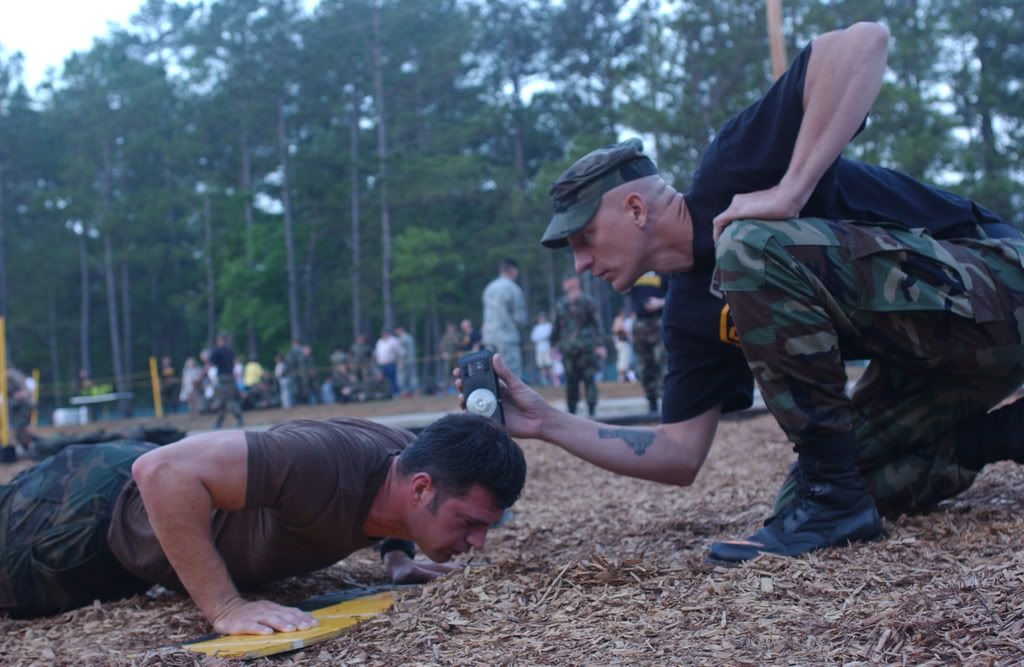
Image result for Army ranger push ups
"Weird; push-ups were easier when I wasn't sleep deprived, freezing, and exhausted"

Adding weight completely defeats the point here; you already did that in the rest of the workout.  Enjoy and appreciate actual bodyweight work for what it brings to the table; an opportunity to fill in the gaps left behind from heavy training and really tap into some crazy volume while giving your joints a break.  In the end, you're always free to spend a few cycles strapping on the dip belt and seeing what you can do, but don't forget all the benefits to be had by leaving the weight behind and moving your body.


Sunday, July 9, 2017

INJURIES ARE FORCED PERIODIZATION

(Before I begin, I would like to point out that the idea I’m about to present isn’t original.  I believe Will Ruth of r/strongman pointed out to me that Steve Pulcinella has expressed this thought, and knowing Steve it’s entirely possible.  Also, I’m not that smart.  That said, this is still something worth discussing to help with some perspective shaping.)

Everyone is adamant that you MUST avoid getting injured in training.  Some go so far as to make insane statements such as injury prevention is the number 1 goal of training, and remaining injury free should be the top priority of any trainee.  To me, these statements are unfathomable, and whenever I see them I find myself in some sort of existential crisis where I wonder if perhaps I just don’t understand how to be a fully functioning human.  How could the number 1 goal of training be SAFETY rather than results?  Wouldn’t you at least have results first and safety as a very close second at the most, if not even further down the line?  When did all these people who text and drive, excessively drink and take showers without non-slip mats suddenly become so safety conscious?

Image result for squatting on a bosu ball
Safety first; have a spotter

But even moreso I am baffled because it appears to me that these people don’t realize the BENEFITS of injuries.  Yes, you read correctly; there is good that comes out of injuries.  And this isn’t simply my normal ranting about how injuries teach you how to adapt and overcome and become tough (though those are all great things); this is about how injuries FORCE you to start training something else.  Injuries are forced periodization; they are a catalyst that force you to start improving those things you have been neglecting up until this point.

And I’m not even talking about the recovery process here.  Yeah, sure, if you go do some physical therapy, you’re going to bring up whatever lagging stabilizer muscles and imbalances you had that drove you to this point.  But that’s not what I mean.  I’m talking about how, when you blow out an ACL, suddenly you find yourself with an ABUNDANCE of time and energy to bring up your bench, press, neck and grip work.  Hurt your back?  Looks like you won’t be able to load it down with heavy squats and deads for a while; guess it’s time to REALLY hammer the prowler and get good at that, because it’s the only way you can hit your legs without feeling agony.  Ruptured your bicep tendon?  20 rep squats with a safety squat bar anyone?


Great time to work on some circus dumbbell too


It is the great tragedy of training, in that, there are so many different ways to train that we’ll never have a chance to do them all.  However, once we get passed the program hopping phase of our youth, we tend to run into the opposite problem of getting settled into a rut.  We find out what works for us and just ride that out for months, if not years at a time.  We grow stagnant and just sort of trickle toward progress.  Well, once we get injured, that option is GONE, and our only choice is to find a way to adapt if we hope to continue training in some manner.  But this adaptations don’t HAVE to be instances of triage; they can be periodization.

People have it ingrained in their minds that, for some reason, when you are injured, you are “less than”, and so should be your training.  You instead need to stop associating your body with your “self”, and realize that you are not your leg, your bicep, your back, etc; you are you.  If a PART of you is hurt, disregard that one part and train everything else as hard as you normally would.  In fact, train it HARDER, because you have so much more recovery available to you now that you aren’t training a part of yourself as hard as before.

Image result for Action figure missing limbs
Plus imagine how much more aerodynamic you'll be!

When you had a fully functioning body, you may have been training legs twice a week and upper body twice a week.  Well guess what you get to do now that you have an injured leg?  If you said “Train the other leg twice a week and train the upper body 3-5 times a week”, you guessed completely right.  Now is the time to chase some sort of crazy stupid upperbody goal, because you don’t have your legs hindering your recovery any more.  Now is the time to finally close the Captains of Crush #3, because you don’t have to worry about saving your grip for deadlifts or strongman events.  Now is the time to develop a 20” neck, because the neck harness is the ONLY thing you can do that doesn’t cause you pain.  Now is the time to see just how many band pull aparts you can do in a day before you catch rhabdomyolysis.  Now is the time to learn how to do a muscle up and then set a record on it.  Etc etc.  You don’t need to do some sort of crippled, truncated, weakened version of your training; it’s simply time to do something DIFFERENT.

And this of course isn’t even addressing the immense psychological benefit of changing your training in light of your injury, in that you won’t be comparing your uninjured state to your injured one.  If you just try to go to the gym and do what you were doing before you got hurt, of course you’re going to fail and get pissed off at yourself.  But if you go in and decide to do something completely different than what you were doing before, you’re going to find that you are JUST as inept uninjured as you are injured.  The challenge of overcoming injury will be masked by the challenge of tackling a new activity, and you’ll be able to progress toward that goal as you heal.

Image result for cool runnings
It worked for these guys!...kinda

Upon your return from your normal training, you will be able to experience the benefits of your forced periodization.  When I blew out my ACL, I spent a LOT of time focusing on my upperbody, and I received a lot of compliments about it.  I was down 10lbs due to leg atrophy but everyone was curious how much weight I had GAINED because I looked huge to them.  My dad was completely blown away when he saw me a year post op, as it was the first time in my life he felt I really had achieved a lot of definition and size in the upper body.  And my bench and press ended up in lifetime PR territory, while I also ended up hitting some PRs on the Captains of Crush grippers.  And all of that hung around once I was cleared to train, and now I’m hitting PRs on the bench and press while having recaptured my PRs on the deadlift and squat.


Hell; it’s almost like I planned it.

Sunday, July 2, 2017

YOUR ROUTINE IS NOT A PROGRAM


I’ve written before how much I despise the “rate my program” phenomenon on the internet, and that hasn’t changed.  However, what I want to discuss today is one of the more annoying sub facets of this situation; that people don’t understand the difference between a routine and a program.  You can typically tell someone has failed before even reading the post, because you open it up and it’s 4 lines long with a list of bodyparts, sets and reps…and that’s it.  That’s no program; it’s a list.  It’s simply a routine; a thing you do day in and day out.  Programs are more; they are systematic, a plan with a goal that is to be achieved.  Your routine is a part of your program, but your routine is NOT a program.

Image result for sisyphus
Sisyphus' routine was to push the rock everyday, but the program was eternal damnation

What makes a routine a routine?  We use the term “routine” typically in the same manner as mundane, with it referring to something that gets done everyday in the same way.  Unless you live in chaos, you most likely have a morning routine that involves waking up, showering, shaving, eating something, etc.  Or you’re super hipster and do intermittent fasting and don’t eat until lunch, whatever.  The point is; this rarely changes, and it’s a set pattern that requires no thinking and it supposed to get you from point A to point B with minimal resistance.

So what is a program?  A program’s purpose is to accomplish an end goal, not an immediate one.  You decide what it is you want accomplished and then set up a program that will carry you through all the various steps to get you from the end to the beginning.  Programs are multi-phased, understanding the intricacies of laying down a necessary foundation in earlier stages to be able to have success down the road.  It takes all factors into consideration before execution and has a necessary plan in place to ensure success.

Image result for squatting on a bosu ball
All part of a multi-phase program to eventually become the only photo I ever post in my blog

Thus, a program is set up of several routines.  These routines are the parts of the program that carry us through the day to day, but they exist as a means to an end, not the end itself.  In your program, you may find yourself with routines that have you performing 3x10, 4x8, 6x6, etc etc for sets and reps, but these aren’t the program.  The program is how all these sets and reps fit in together.  It’s how you start out with something a little higher in volume, before you transition the volume away and up the intensity, before you peak, before you start all over with a focus on conditioning and base building.  That’s a program that was set up for 4 different routines.

This seems obvious to the experienced trainee, but to a novice the ideas are interchangible, and this is where confusion and starts.  A trainee thinking that a routine and a program are one in the same is inclined to adopt a routine AS a program.  They take on a 5x5 routine and say “THIS is my program”, and they follow it right off a cliff.  Through rain, shine, sleet, snow and slush, through feast and famine, they keep pounding the same routine over and over again in the vain hope that it’s actually a program that will get them to their goals.  Progression?  Why, I’ll simply add more weight.  Volume and intensity?  What’s that?  All I need are my 5 sets of 5 reps.

Image result for stronglifts meme
Yeah, I know that's 3x5, but the internet is just making a TON of these

Routines are comforting.  It’s why we settle into routines in the first place; they remove thinking from the equation and allow us to go into autopilot.  If you have pets or children, you know that one of the best things you can do for them to curb anxiety is to give them a stable routine, so that they have comfort and security in knowing that life is not chaotic.  However, there is another term we use when referring to routines; ruts.  We fall into ruts, we settle into ruts, we end up in ruts, and ultimately, once we are there, we stagnate and die.  Recognizing we are in a rut is a step toward progress, as it’s establishing that there IS a problem, yet so many trainees are in such a rush to be in a rut that it seems to BE the goal.  So many times the question is asked “what is your routine” and not “what is your program”.

We seek to program, and the defining factor IN a program is a model of progression.  The key word in progression of course being PROGRESS.  We seek to progress from where we were to where we want to be.  And this is why a progression model in a routine needs to be something that is logical and sustainable.  This is why making the progression model an afterthought is the calling card of a beginner on a quest to stagnate as hard and as fast as possible.  “I’ll just add more weight everyday” isn’t a thought; it’s a meme.  People will spend hours, if not days and weeks painstakingly laboring over if they’re going to do leg presses with their toes out or toes in as part of their assistance work, or debating on if they should do sets of 8 or sets of 9, or figuring out if they should do hammer curls AND reverse curls in their ROUTINE but won’t even invest 15 minutes figuring out how they’re going to actually progress.

Image result for leeroy jenkins meme
I admit I DO have to admire the tenacity

Do whatever movements you want.  Do however many sets you want.  Do however many reps you want.  Train 3 days, 4, 5, 6.  Do twice a days.  Use bodypart splits or full body.  Train only the left side 1 day and only the right side the next.  Do whatever routine you want; just make sure it fits in your program.


Saturday, June 24, 2017

QUIT WASTING YOUR REST TIMES


My grandpa once told me “if you want to make time pass slowly, just hang by your thumbs.”  At this moment I’ll explain that my grandpa had a lot of psychotic homespun sayings and a great talent with metaphors that I hope I partially inherited, but I particularly liked this one because it’s hilarious.  But the point to take away from it is that the passing of time is a set principle, but our perspective of it can always be altered based on circumstances.  Time flies when you’re having fun, and it slows down to a crawl when you hang by your thumbs.  I think many of you folks out there are watching time fly by during your rest times, because you’re too busy having fun NOT being miserable to really appreciate just how MUCH time you have in your rest times.  Once you stop wasting your rest times and actually getting some work done, you’ll realize how long an hour long workout REALLY is, and how much training you can get done during that time.

Image result for navy seal flutter kicks
"In retrospect, the wait for Game of Thrones seems really fast compared to waiting for this guy to stop spraying me with a hose"

Alright, so first, I already know what people are going to say.  “You idiot; it’s a REST time.  You’re SUPPOSED to be resting.”  Ok shut up for a second.  I will grant you that, during rest periods in a training session, you should rest from the movement you just completed, but this doesn’t necessitate achieving a catatonic state gazing into your smartphone swiping right (that’s apparently some sort of thing).  You can rest from previous work while still engaging in OTHER work that doesn’t necessarily hinder recovery.  This requires a somewhat intelligent approach to training, yes, but most people are so willing to look up every study, article and book on training at this point that I can’t imagine I’m upsetting anyone by suggesting bringing a little intellect into the game.

Yes; you CAN recover WHILE working.  Some even theorize that work AIDES in recovery (I need to use italics more, as writing “aides” in all caps became dangerously close to getting offensive).  When we perform 1 movement and then perform another movement that is oppositely aligned to the previous, we force blood to flow through the muscles opposite ones previously worked, which some theorize to be incredibly restorative.  Even if that were not true, we still understand that fatigue is a LOCALIZED concept as it relates to muscles; not a general one.  If you crank out 400 reps of squats, your legs will be obliterated, but your pecs are still fresh and ready for more work.

Image result for cycling big legs
Looks like they're still waiting too

So if muscular fatigue is localized, what really limits us from engaging in some hardcore, nonstop superset training until death?  The answer isn’t going to shock you; conditioning!  Muscular fatigue is local, but conditioning is general, and it is our conditioning that is taxed and limits our ability to really have significant output on opposite movements.  Once again, going with squats, if you do 40 rep squats, your pecs might be fresh for more work, but most likely you’ll be too busy vomiting up your lungs to be able to put in a solid set of benching.

So how do we approach this situation?  Well, regarding the conditioning piece, that answer is obvious; have BETTER conditioning.  This is WHY conditioning is so key; it’s a gatekeeper to greater training density, which means effectively more volume, which means more growth.  If you work diligently to improve your conditioning, you will be able to accumulate significantly more volume over time, which means greater growth overall.  However, what do we do in the meantime?  We take something of a training wheels approach to rest time work.

Image result for training wheels for motorcycle
And you thought buying a motorcycle would make you tough

In the era of “all compound movements, all the time”, there have been a lot of little movements that have been overlooked and neglected for years.  This is primarily because of dogma, and primarily because, after doing a whole bunch of heavy compounds, trainees found themselves too spent to do anything else.  So start working these little movements in during your rest periods.  Between sets of squats, benches, presses and deadlifts, start working in pull aparts, face pulls, curls and raises.  Don’t work to failure or even close to it; just focus on accumulating volume.  A set of 20 pull aparts isn’t much of anything, but done 5 times in a workout while you’re huffing wind from squats becomes 100 reps.  Performed everyday is an extra 700 reps a week, or 36,400 reps in a year.  Think that doesn’t add up?  You’re getting in more work and not compromising your recovery at all.

That’s not all you can do though; you can also use rest times to start setting up your next movement.  If you train full body, you can start warming up for bench during your squat worksets, or you can start loading the bar for your next assistance movement while hitting your main movement.  You can eliminate wasted time so that your training is more efficient, which in turn allows your training to be more dense and allow for greater volume overall.  And again, we do this to accumulate more growth.

And once you have a mastery of your conditioning, you can do BIGGER and heavier movements during your recovery periods.  You can do worksets of bench between worksets of deadlifts and STILL recover from both.  You can run giantsets of squat, chin and press and be able to give each movement due diligence.  You can be in such great shape that you have the ability to push hard while recovering FROM pushing hard, and in turn, you can turn an hour of training into a very brutal and efficient hour of solid training, rather than 6 minutes of training accompanied by 54 minutes of resting.

Image result for squat injury
Ok; maybe take an extra minute to rest from this one

And let’s say that you end up lifting less weight because you are fatigued; who cares?  You are STILL getting stronger if you’re training to the same rate of perceived exertion as before.  Your body doesn’t exist in a vacuum; it doesn’t NOT adjust to stimulus simply because it weighs less if that stimulus is presented when under a state of fatigue.  If this was TRUE, things like pre-exhaust, pyramid sets and dropsets wouldn’t work.  And though some eggheads might not understand HOW they work, we have more than enough proof that they do.  Let your lifts dip a little knowing full well you are STILL getting bigger and stronger because you’ve changed the degree of fatigue you are training under.

Rest times are an opportunity, and you can choose to exploit it or squander it.  Hang by your thumbs in training; spend more time TRAINING in your rest times than you do training during your training times, and see how you turn out.