Wednesday, April 12, 2023

COMPLETE OVERHAUL PART 1: NUTRITION

This is going to be a large undertaking and I may end up writing it in a few different parts as a result, but since its my blog I get to write what I want, and this is what I want to write about right now.  People that follow my training log already know what’s going on, but to catch you up: after I ran Super Squats for a third time in my life (with my second time resulting in me tearing my hamstring after contracting RSV, then taking 6 weeks to run a higher intensity program wherein I tore my lat/tricep, then another 6 weeks of Super Squats capping out with a 20x405 squat, crippling elbow pain, a swollen right knee and hip and a pinched nerve in my back that took another 6 weeks to heal), I was in desperate need to do something different.  Alongside my various physical ailments that came with effectively tearing my body apart every time I trained and then eating as much as possible to put it back together: I was dealing with the fallout that came WITH eating that way.  I had forgone the recommended gallon of milk a day with Super Squats because it wasn’t nutritional behavior I wanted to model for my kid, but, in turn, I was ALWAYS EATING. The sheer volume of food necessary to support the training was absurd, and my whole life revolved around food.  Buying it from 4 different grocery stores/online, bringing it all home, cooking it, storing it, eating it, cleaning up after it, and passing it through my system: I had no time for anything else.  


Change was needed.


Something more than just switching from regular to chocolate


VELOCITY DIET/APEX PREDATOR DIET INTERVENTION
High velocity apex predator you say?


Ever since I read “Never Let Go” by Dan John, I’d been interested in “The Velocity Diet”.  A super quick overview of that is: a 28 day fat loss diet comprised of protein shakes and fish oil capsules and that’s it.  I dug the idea behind this protocol because it sounds like something I would do: intense and ridiculous.  BUT, as a parent and husband, the idea of spending a full month NOT sharing meals with my family was a non-starter.  That time is precious, and they already deal with enough of my insanity on the daily.  I try to minimize my burden by training before they wake up and committing my nutritional deviance away from them while I’m at work…which is why, when an updated version of the Velocity Diet was released that included a daily “Healthy Solid Meal”, things became a LOT more viable.


Alongside that, readers of the blog know that I’ve reviewed Jamie Lewis’ (of Chaos and Pain/Plague of Strength fame/infamy) “Issuance of Insanity 3” wherein he lays out the details of his “Apex Predator diet”, which, itself, was based around the OG Velocity diet and given Jamie’s personal spin.  Rather than being specifically a fat loss diet, Jamie’s approach was more modular, and could be adapted for a variety of goals.  In turn, his approach allowed for up to TWO solid meals a day alongside a battery of shakes. 


I relate too well to this


And herein I re-discovered something that has been pretty successful for me in the past: have TWO.  Here, it’s two diets, but it also works with two training protocols.  By having at least two options, I double my chance of success, because if I fail to meet ONE protocol I can still work to achieve the other.  In that regard, I went on what I deemed my “family man Velocity/Apex Predator Diet”, as I was taking the two diets and mashing them together to meet my needs.  If I “failed” on the Velocity Diet by having “too many” healthy solid meals in a day, it meant that I could still meet the Apex Predator diet’s protocol.  And if I “failed” on Apex by having too many carbs in a meal, it could STILL be a “healthy solid meal” ala the Velocity Diet.


I will now lay out in greater detail the specifics of my deviance, alongside observations and lessons learned.


A TALE OF TWO DIETS


If only...


* Breakfast with my kid every morning is precious, and I still wanted to sit down and EAT with my kid vs drink a shake with them.  There was a “cool tips” section on the Velocity Diet that talked about mixing in just a small amount of water to make a pudding out of the powder.  I was able to accomplish a similar feat making “oatmeal” by taking a tablespoon of riced cauliflower, nuking it in the microwave for 55 seconds and then mixing 2 scoops of protein powder and a trickle of water.  Stirring the water in slowly would create a paste-like texture which answered the mail completely.  I’d throw in some cinnamon and salt and the charade would be complete.  With that, I already had ONE meal solved and still complied with the intent of shakes for my meals.


* Alongside that, the Velocity Diet is 4 shakes a day: breakfast, lunch, midday and bedtime.  I get up between 0300-0400 to train, and if I have my “breakfast shake” then…I’m not gonna have it when it’s time to have breakfast with my kid.  Alongside that, if I push it off and DO have breakfast with my kid, that’s still like 0600.  It’s a LONG time between breakfast and lunch then, and I’m “post training”, so I’m wanting protein.   A few solutions: I move the midday shake to a mid-morning shake, as I found that I was really forcing the midday shake down anyway with a lack of appetite while I was RAVENOUS come mid-morning.  But the other solution I took was to steal from Apex Predator and have a shake in the middle of the night when I’d get up to pee (which I could rely on, since I was stupidly hydrated through this process).  This would just be a 1 scoop shake, but it meant I wasn’t training fasted and ALSO allowed me to speed up my pre-training ritual in the morning by being able to just roll out of bed and get after it.


Pretty much that


* Jamie recommends some sort of multivitamin to cover nutritional basis during the Apex Predator Diet alongside Omega 3 supplementation, which the Velocity Diet cover through use of “Superfood” and “Flameout”, which is what I used.  It honestly IS reassuring to use those products.  When I have a more diverse diet, I don’t ever sweat vitamins, but now that I’ve almost entirely phased out vegetables, nor am I getting in my whole eggs all that often, the inclusion of these supplements allows to push on without worry.  Also, Dan John, Jon Andersen, Jamie Lewis and Chris Shuggart are all onboard with sugar free Metamucil too.  That helps a lot.


* On my “normal” work weeks, I’d have midday meals on Tues, Wed and Fri.  Those are the days I could meet my wife for lunch.  I’d make this meal an Apex Predator style “meat on the bone” meal: typically chicken drumsticks.  Dinner that evening would be a leaner meat and trace veggies (running opposite of Jamie’s suggestion of a leaner midday meal and meat on the bone in the evening).  Mon and Fri was typically 1 solid meal a day, more akin to the Velocity Diet, and when possible I’d try to make it meat on the bone, but otherwise it’d be a lean meat and veggie meal.  Some weeks, I managed to get in the Protein Sparing Modified Fast ala Apex Predator or a Velocity Diet 1.0 day of pure shakes (same thing basically) 1 day a week.


I mean, the precedent is there (man, lotta Simpsons on this one)


* Weekends were where the “family man” aspect shone through, but ALSO where Apex Predator really helped make this all work.  Jamie has a “Rampage day” and a “High calorie keto day” in his diet.  The Rampage day is a basically the reverse of the entire diet: moderate carbs meals through the day followed by a 3 hour “rampage” window that is a lot of carbs and calories to top off glycogen stores and reload for the rest of the week, alongside cycling calories in the diet to keep the metabolism humming.  For me, this meant a social meal with the family on the weekend where we got to eat some fun food, alongside solid meals through the day.  I’d have shakes for snacks, but that’s about it.  The high calorie keto day would be my other day of that weekend: a meat and egg heavy breakfast and then meat centered meals for the rest.  These were days where I was with my family all day, which meant having meals with them the whole time, and these two days were perfect for that.  Jamie prefers these two days to NOT be run right next to each other, but Chaos remains the plain.  I was absolutely still getting results from this.  However, those Rampage days definitely did a number on me: I am so NOT carb adjusted that a little bit goes a LONG way.   Spent a lot of weekends sweating profusely from the insulin shock and trying my absolute hardest not to slip into a coma.


* Because my carbs are so low, I had to start adding salt to all of my protein shakes.  Low-carb dudes know this exact problem: your body is bad at holding water and balancing electrolytes without carbs.  On the plus side, the salt actually enhanced the sweetness of the shakes, which is a baking trick.


EXPERIENCES, OBSERVATIONS AND LESSONS LEARNED

Sorry to let you down Stan!


* I have become stupidly lean, and fat loss wasn’t even the goal.  I dropped 11lbs of bodyweight in the first 26 days of NOT supergreat compliance, as the second week of the protocol I had family in town and spend 5 consecutive days eating 3 solid meals a day on top of the shakes.  I’ve stayed on the protocol for even longer, currently in my 6th week of the protocol, with no real intention of stopping.  This is less a “diet” and more a lifestyle.


* I’m experiencing ZERO performance degrades with this approach.  Now, sure: I’m not running Super Squats off of it, and if I were to try to take on a hypertrophy block I’d have to do some tinkering (more on that later), but I’ve been seeing weights go up in the gym while bodyfat goes down, I ran a 10 mile race with minimal prep (a 5 mile run 2 weeks out and a 5 mile run 1 week out, preceded by 50 weeks of no running), and I do not feel beat down or fatigued.  This has also taught me just how little I “need” to perform.  I used to have a HUGE meal before bed every night…


Big omelet, cottage cheese, veggies, meat, lotta nut butters on celery, toast, and other keto junk


*…thinking that I “NEEDED” that food to help me sleep through the night AND have fuel to train off of in the morning.  These days, I’m eating 2 scoops of protein powder in an oatmeal before bed, having my “wake and shake” in the middle of the night, sleeping well and training hard first thing in the morning.


* This approach totally gels with my “no counting calories” approach.  There’s no thinking nor is there any doubt: drink the shakes dummy! I KNOW I’m getting enough protein to spare my muscles and I know fat loss is going to happen unless I eat the STUPIDEST HSM possible, at which point I’ve most likely dropped the “H” from it.  It’s really just “set and forget”, which clears up a LOT of mental bandwidth.  That was the big goal OF this undertaking: I needed food to STOP consuming my life, and this totally did that.  I have to think about ONE meal a day, and when I co-opt Jamie’s approach even THAT meal is simple.  “What are we eating today?  4-6 protein shakes and chicken drumsticks.”  One week, my wife was away on business, and I had no issue making my kid “to order” dinners while I just batch made a BUNCH of chicken drumsticks and had them every night.  It was the simplest week ever.


"Meal prep" really doesn't get easier


* “Packing” for work is just so much simpler now.  I used to have to bring a cooler FULL of food, which I’d pack every morning, and it’d eat into so much of my morning time.  Now, I’ll throw a bag of protein powder in a bag, bring that to work, and it makes up the majority of my meals through the week.  When the bag runs out, I bring another.  I make sure to have my other supplements, and a few times a week I pack a solid lunch…but that’s it.  Once again: less bandwidth.  I also GET to work much earlier now, because I don’t have to spent 30 minutes cooking and cleaning up breakfast.  It ALSO means I get MORE time to train, because, again, it’s time I don’t have to spend on food.  To say nothing of the time I save SHOPPING for the food.  Which, from the “family man” perspective, is a huge win.  I have SO much more time with my family now.  THAT has been one of the biggest draws to this overhaul, and why I have no real plans to change course.


* My digestion is the best it’s been in YEARS.  Introducing Metamucil to my life was huge in the first place, but the sheer volume of food I was eating was just tearing up my guts something fierce.  A primarily liquid based diet with 1-2 solid meals a day is SO much more manageable, and, once again, it means less time spent voiding the food.  Wins all around.


* My relationship with food is ALSO substantially repaired.  I’m no longer food obsessive, because the majority of the nutrition is already decided.  And when you only eat 1-2 meals a day, you learn to APPRECIATE those meals.  Food tastes and smells delicious and is absolutely enjoyable.  I need no artificial sweeteners or science fiction/Frankenfoods: REAL food is a treat.  I had so much “keto junk” in my diet: keto bread, keto wraps, keto syrups, keto cookies, etc etc.  It’s all just re-branded junk.  Now, I get such limited opportunities to have food that WHY would I waste it on that junk when I can have some REAL eggs, some avocado, some real meat, etc?  Even my Rampage meals tend to be just hearty real food.  A decade ago I was doing low carb all week with 1 weekly cheat meal, and it was always a fast food binge.  And “binge” is the right word: I would eat as FAST as possible so I could eat as MUCH as possible. That is NOT healthy in SO many ways.  Now, I savor my food, enjoy the taste, and enjoy the company.  I’m enjoying the EXPERIENCE of food: I’m re-discovering humanity.  I’m also NOT afraid of those things that I can find in nature.  My LDL scare a while back had me TOTALLY dietary fat phobic, with animal fats in particular triggering some serious anxiety.  Now, I’m not going to let cheese or chicken fat get in my head, because I’m not LIVING off of that: it’s my 1-2 meals a day.  Knowing that nutrition is “on point” so much means that any deviation isn’t even worth worrying about.


A "healthy solid meal"


A "Rampage" meal, that is still pretty darn healthy


* Alongside that, I’m trying out things I had previously written off in my life.  I used to lean primarily on diet soda for my caffeine source, having not cared for coffee.  Now, plain ol’ black coffee is fantastic, which is great, because Jamie wants you to put away a lot of caffeine for Apex Predator and this makes it easy to comply.  And I’m pretty happy to not be putting away a bunch of chemicals from drinking a gallon of diet coke a day.  

As predicted: this grew HUGE and I haven’t even scratched the surface of how I’ve changed up my training or my random spitballing and theories to follow.  I’ll write that section in a bit and release these in pieces so they’re a bit more digestible (hah!  Nutrition pun), but allow me to throw in a quick summary.


SUMMARY AND TAKEAWAYS

No you idiot!  We were so close!


* Eating to sustain 2 rounds of Super Squats forced me to seek a change, and in order to satisfy my desire to take on challenges, I leaned toward the Velocity Diet/Apex Predator Diet.


* Having TWO diets to follow allowed me to have more ways to succeed rather than more ways to fail.  It also allowed me to meet my goals of making this approach fit in while prioritizing my family.


* Some might theorize that a diet of primarily protein shakes with 1-2 solid food meals a day would create a damaged food relationship/body, but it did the opposite.  The food I get, I value, my body is performing well, and I have more time with the family and less time obsessing over food.  This is also a great fit for non-calorie counters, and, in turn, if you find yourself obsessing in THAT regard, it might be worth trying that way too.


Thursday, April 6, 2023

IT SHOULD SCARE YOU


Readers, I’ve once again taken off on a wild tear tilting at windmills with a new protocol and program.  After reading Jamie Lewis’ “The Feast, Famine and Ferocity Diet” ebook (which is absolutely fantastic, along with the bundle he’s currently selling at plagueofstrength.com), I was all too ready to take on the “Famine” training protocol, and am currently midway through the first week.  Jamie has actually given me permission to do full uploads of the workouts on my youtube, so feel free to check them out to get an idea of what the lifting looks like.  And part of the reason I took on this training program was because I was already in the process of following Jamie’s “Apex Predator” diet, itself a variation of the T-nation/Biotest “Velocity Diet”, which, in turn, is very close to the nutritional protocol advocated IN the “famine” phase, so it was a pretty easy switch.  I’ve been logging all of this in my various logging locations, and perhaps it’s the copious amounts of caffeine I’m consuming alongside this protocol, per the recommendations (I’ve re-discovered black coffee, but this time ALSO discovered a love for it), but I’m genuinely excited to eat and train again, which is something that typically only occurs when I have a competition on the horizon.  But, in turn, upon looking deeper, I realize that this has occurred other times in my training history: when I began “Building the Monolith”, when I began “Deep Water”, when I took on my own 6-month gaining block, and each and every time I ran Super Squats.  And, in turn, I’ve identified the common variable: before starting all of these protocols, I was scared of them.


This is scary for all sorts of reasons

In disclosing that, I need to one again re-iterate that I am in fact human.  All too human.  It’s too easy for people to write me off as a machine, or insane, or a bit of both (Futurama proved that they do exist), but the truth is, when you prick me, I do in fact bleed.  The only difference between me and “normal” people is simply WHERE my limit is, but I DO have limits just like everyone else.  In turn, I will read a training or nutritional protocol on occasion and immediately say “Oh f**k that”.  That is fear.  That is my mind taping out and saying “No”.  It absolutely happened the first time I read the Deep Water e-book and got the program and saw the 10x10 squats that had a reduced rest time over 6 weeks.  It happened when I read Randall Strossen suggest drinking a gallon of milk to survive Super Squats, or Jim Wendler suggest a dozen eggs and 1.5lbs of ground beef.  I actually BOUGHT the Deep Water e-book and had it in my kindle for a full year before I ever ran the program…because what happens is, I say “f—k that”, put the book away…and then it gets inside my head…


…and I begin to think “…well HOW could I make that work?”  For Building the Monolith, it was “HOW could I do that in an hour?”  For Deep Water, it was “What day could I put the 10x10 squats so I could get it done?”  For Super Squats, it was “how much milk will the college dinning hall let me take home?”  and then 15 years later “How much FOOD will I need to eat if I won’t drink the milk?”  THIS, in turn, is the facing OF these fears.  It’s my own personal “exposure therapy”, where in my own headspace I manufacture the necessary degree of safety in order to encounter these fears.  I create control of the variables that I CAN control so that I can assert myself over these things that generate fear, which, in turn, allows me to encounter, face them, and eventually conquer them.  And, in turn, that’s what allows me to have a greater threshold limit than most: I’ve simply DONE this more.  I’ve been around longer.  Like an RPG: I’ve been grinding, so I’ve leveled up, but we’re all still the same character class.


I am absolutely a level 100 Magikarp

But all these programs I’ve mentioned are ALSO the ones that I credit with creating the MOST profound physical transformations in me.  Much like my most recent post on doing what you’re bad at to get big and what you’re good at to get strong: doing these things I was afraid of triggered a necessary growth response, whereas doing the things that looked like they’d be “fun” or “easy” were the things I did when I needed a break.  And this, of course, speaks to the consistent recurring them I keep noting, the “will to power”, and how, in order for the body to grow, it has to be subjected to a stimulus that tells it “if we do not adapt, we will die”.  The body MUST be afraid of the current environment in order to be triggered into changing, for absent such fear, it will have no motivation or catalyst for change.


Which is “the rub” when it comes to this pursuit of physical transformation: we must seek out exactly what which we fear in order to grow.  And no: this is NOT masochism.  That defeats the purpose.  The masochists seeks out exactly what it is that they want: pain.  They enjoy pain, revel in it, desire it: when they receive it, they are satisfying a want.  That’s just another form of hedonism.  For the masochist to grow, they would have to intentionally seek COMFORT, as paradoxical as that seems.  But for those not-afflicted, it’s a far more straight-forward process: when you look at a training or nutritional protocol, if you want it to create physical transformation, it should scare you.  At least a little.  SOMETHING about it should seem terrifying.  Some aspect of it should seem…wrong.  It should be different.


Too far


For many, this “fear” is going to be fear of the unknown.  In fact, I’ll say that for MOST that is the very fear that must be experienced.  I have known trainees that have stalled for YEARS because they refuse to abandon their paradigm of “what works”.  The irony, of course, is lost on them that “what works” STOPPED WORKING.  The “sets of 5” acolytes that REFUSE to use any other rep range, the “must hit each muscle twice a week” gurus that only know how to lift weights 6 days a week to train, the HIT Jedis, the bro-splitters, the camps that either can’t figure out 5/3/1 or can’t do anything BUT 5/3/1: it’s all the same.  You MUST be willing to make that jump without the parachute in order to actually get that growth that lies beyond what you know.  You must face the fear of NOT having a map and simply getting lost in the woods and hoping you can find our way out.


And what’s wild is: you face THAT fear often enough and you suddenly develop the habit of seeking out these uncharted territories and exploring them.  People will think you’re fearless, but no, quite the opposite: you’ve become a fear JUNKIE, because you KNOW that it is this constant exposure to and overcoming of fear that creates growth.  You establish a new baseline of “bravery” with each successive attempt, wherein it takes more and more to scare you which, in turn, opens up avenues for even crazier methodologies that may in fact lead to some even wilder success.


To think Milo of Croton merely LIFTED the bull...


Start small, sure.  Find something that scares you a little…and conquer it.  Then find the next thing and conquer that.  Think of what program or protocol you’ve had in the back of your mind for a while now and resolve to take it on.  It SHOULD scare you. 

Thursday, March 30, 2023

A THEORY: DO WHAT YOU ARE BAD AT TO GET BIG & WHAT YOU ARE GOOD AT TO GET STRONG

So here’s something that’s been resonating with me for a bit now, and I’m stealing from Dan John, of course, because geniuses invent and winners steal.  But Dan talks about how he equates himself as a “hinge-pusher”, meaning that, in the realm of “push-pull-hinge-squat-loaded carry”, Dan primarily gravitates toward hinging and pushing.  He is excellent at the Olympic lifts, the swing, the deadlift and pressing weight overhead, and he struggles with squatting and chins.  And when Dan designed a program for gaining mass (Mass Made Simple), it was based around the high rep squat.  Dan gives an outstanding reason for it in the Easy Strength Omnibook, regarding how the body seems able to perform high reps of squats to an almost unlimited capacity compared to deadlifts and why it’s best suited for mass gaining….but when looking at Easy Strength, there’s something else worth observing: Dan advocates AGAINST using the squat there.  Here we observe my own curiosity: for getting bigger, Dan is doing the thing he’s bad at, and for getting stronger, he DOESN’T do that thing: he does what he is good at.


We all pay something don't we?


As a fellow hinger and not a squatter, I totally relate to Dan.  I was able to cat-back deadlift 540lbs without a belt when I was 22, but I STRUGGLED to get my squat to 400lbs.  I did the 10k swing challenge in a week as a deload, and my most recent run of Super Squats almost broke me, to say nothing of just how horrible all those squats LOOKED while I was doing them.  I have no upper torso and am all limbs.  I’m built to hinge and NOT built to squat.  And, in turn, the programs that forced me to grow the most are the programs that have been built around squats.  Whenever I dedicate time to squatting, I grow.  And my longtime readers will know that I’ve even observed that focusing on the front squat in particular REALLY triggers a hypertrophy response for me: the SQUATTIEST of squats.  Meanwhile, the Safety Squat Bar does NOT create this effect in me, primarily because I can absolutely hinge squat that squat and play to my strengths rather than my weaknesses.  Heck, this is why I use a buffalo bar: it forces me to hold the bar slightly higher up on my back than I can with a straight bar with sharp knurling.


And since I’m such a bad squatter, it’s not something I’ll naturally pick to do, which means programs that make me do a LOT of squatting make me grow, because, again, I’m bad at it.  Super Squats might be “just 20 reps”, but, of course, they’re 20 HARD reps, and they’re done 3 times a week, so now we’re looking at 60 reps in a week, and 120 in 2 weeks.  Deep Water is obvious in just how much squatting you do with it being 10x10, and even though the frequency of it is once every 2 weeks…it’s a LOT of squatting.  I hate it, it’s not what I’m good at…and it makes me grow.


Also true


Know how I squat when I wanna get strong?  Zeno squats.  I’ve written about that before, but for the unfamiliar: Zeno Squats are named after Zeno of Elea, who had a paradox of motion that described how motion was impossible, because for an arrow to travel from point to point, it must first travel half the distance between those two points, and to get there it must first travel half the distance between THOSE two points, etc etc, going on forever, proving the arrow could never move in the first place.  I made it cute by taking a weight I could squat for 8 reps, doing it for 6, racking the bar, taking 12 deep breaths, then doing 3 reps, rack, breathe, 2 reps (half rounding up), rack, breathe, 1 rep, strip weight off, repeat until death.  I do Zeno squats ONCE a week, and when it’s all said and done, I’m looking at something along the lines of 24 reps at the first week.  The next week, I add ONE rep to that first set and let the waterfall effect occur, but even still, it takes SEVERAL weeks before I accumulate any meaningful volume on the lift, but my strength goes up leaps and bounds whenever I do it…and I don’t ever grow particularly big from it.


A similar effect when it comes to deadlifts: my most effective deadlift strength protocol has been ROM progression deads.  There, I don’t even pull a full ROM deadlift until week 7, and leading up to that we’re looking at a total of 15-25 reps a week on the pull.  Stupid low volume, doesn’t make me grow, DOES make me strong…and it’s what I’m GOOD at.


Some of us are just gifted


And, in turn, this is ALSO why, when I want to grow, I follow someone ELSE’s program.  Primarily because someone else is going to make me do something I don’t want to do.  And when I want to get stronger, I do my OWN programming, because I know what I’m good at, and it’s what I’ll do.  Every strongman competition and powerlifting meet I’ve won, I’ve done so with my own programming.  When trying to use someone else’s, I fell flat.  Meanwhile, whenever I’ve tried to design a “hypertrophy program”, it was a bust.  Yes, I’ve co-opted lessons learned into other programs to modify them, but ultimately the base and foundation had to come from outside in order to me to actually grow.  


Continuing on this theory, here’s my thought: the body grows muscle as a necessary adaptation to a threat to its existence.  The body does not like to change, and will only do so if the consequence of NOT changing is more significant than the consequence of changing.  When the body feels that its very safety is in jeopardy unless it changes: it will change.  In turn, we must subject it to a consistent dosage of what it is BAD at in order for it to create that catalyst for change.  The body will encounter the dissonance inherent in constantly attempting to perform a task it is poorly suited for and will continue trying to force some sort of adaptation in the hopes of remedying this situation.  And we use this knowledge to our advantage: we find what our body is weak at and we play to our weaknesses.  It’s downright cruel.


"This never would've happened to Samson!"


The above is an example of SURVIVAL.  The body is doing the things it needs in order to survive.  The opposite of surviving is THRIVING, and when we thrive, the body no longer is attempting to adapt but, instead, it settles in and fully realizes itself.  When the body wants to survive, it enters a state of “fight or flight”, and it does some pretty cool things from a biological perspective to maximize our chances of survival in that instance.  Digestion shuts down, pupils get smaller, cortisol raises, etc etc.  All cool things from a survival standpoint…and absolutely terrible and destructive in the long term. Looking at people that have SURVIVED harsh, prolonged experiences (like POWs) demonstrates just how capable the body is at adapting to prolonged survival AND how destructive it can be.  Without even meaning to, I’ve just brought up the value of periodization in training, but my real intention here was to demonstrate the differing biological processes the body undergoes when it’s allowed to SURVIVE rather than thrive.  But let’s talk to that now.


A body that is thriving is geared toward consistent self-improvement and self-actualization.  We go to Maslow’s Hierarchy of Needs there.  The body wants security, food, shelter, etc etc, and once it has all of that, it gets to start thriving.  When we transition the body AWAY from the things it’s bad at and allow it to consistently perform the things it is GOOD at, it responds by getting better and better at what it is good at.  It’s not adapting: it’s THRIVING.  This is why these gains can be reached in a caloric deficit: the body is in such a natural state of excellence that it no longer requires excessive fuel to perform its functions, but can instead “effortlessly” execute its mission.  It responds to being tasked with its strengths by getting stronger.   


I still think Juggernaut is cooler though


The common wisdom is to ALWAYS do the things you’re bad at so that you have no weaknesses, but I feel like this speaks to the duality of needing time to play to your strengths and time to shore up your weaknesses.  Someone that ONLY brings their weaknesses up to their strengths is simply mediocre.  We can always make our strengths equal our weaknesses by making our strengths weaker…but that’s silly.  When I ruptured my ACL, I trained my other leg as hard as I could, and people asked me if I was worried about imbalances, to which I said “I’d rather have one strong leg than two weak ones”.  So know what you’re good at and what you’re bad at so that you can know when to train which!      


Monday, March 6, 2023

RORSCHACH TEST

I took exactly 1 class of psychology in my undergrad (which would be, of course, psych 101) and learned enough to know that the human mind is fascinating and I am well out of my depth trying to discuss it, so anyone who actually knows anything about the subject: forgive my cultural appropriatism here, but I’m going to talk about the Rorschach test.  For those unfamiliar, this test, also known as the “ink-blot” test, involved showing the patient a series of ink blots, asking them the first thing that came to their mind upon seeing them, and using their responses as a method of psychological evaluation.  I’m not going to pretend to understand the nuances of such a process, but if I show one person an ink-blot and that person says “ice cream” and the second person says “arson”, I’m watching that second person a little closer.  But even without the requisite education in psychology, we can learn from this test, primarily in the sense that YOUR first response when presented with an idea can be quite informing of how YOU perceive the world.


Check it out: philosophy, psychology AND chaos all in one shot...and a corndog!


Case in point?  Hard training.  Boom: what did you think?  It’s so amazing how, when I say “hard training”, trainees either stare blankly at me, or ask if I mean “train 6 days a week” or “take every set to failure”.  Right away, your initial response is telling ME that you don’t know how to train hard.  Because, right away, you’re trying to make “hard training” a mechanical process rather than a human one.  You’re trying to set up the parameters OF the training the CREATE hard training, and that’s an artificial construct that simply will not gel with the humanity element at play when we discuss training.  Hard training is training wherein you pour every fiber of your being INTO the training.  “Every set to failure” doesn’t mean that, because I’ve seen how some of you cats “fail” a lift: you had at LEAST 6 more reps in you if you were actually willing to push through the pain.  To say nothing of how, whenever someone says they take “every set to failure”, I know I’ve found a liar.  You mean to tell me that, on 3 sets of squats, for every set, you let the bar crash into the pins, unload all the plates, rack the bar, re-load all the plates, and then do that again for the next set?  No: stop.  And train 6 days a week?  How do I know you’re not training hard?  You can do it SIX DAYS A WEEK.  By the end of Super Squats, I was good for ONE hard workout that week.  But I get people REAL mad when I say this, so let’s move on to nutrition to further alienate my readers.


Ah yes, nutrition.  Did your mind immediately jump to supplements?  Did you think protein powder, weightgainer and creatine?  Notice how these are SUPPLEMENTS?  They’re supposed to augment what is missing from your diet.  What FOOD are you eating?  When you read “food”, did you think “Uber Eats?”  McDonalds?  Did you think frozen dinners?  Did you think of 1500 calorie shakes?  Did you think of ANYTHING that requires actual cooking?  Have you thought of a single vegetable yet?  It baffles me how much time and energy we invest in trying to get trainees to eat like a human.  Cooking doesn’t need to be a 4 hour affair: it can be done quickly, efficiently and effectively, especially with all the modern amenities available these days.  And with the impact of inflation as of the time I’m writing this, there’s no way you can tell me that eating out is cheaper than making something at home.  Nor is it faster.  And this is the stuff you are putting IN YOUR BODY to achieve physical transformation.  Why WOULDN’T you pick stuff that is the closest to real, human food as possible?  Why would you want to transform off of something with an ingredient list that reads like a chemistry paper?  


Oh f**k me: just make a grilled cheese sandwich


And that’s just “food”.  Now what if I say “eating”?  Right away, the calorie and macro calculators come out.  You go about this whole process backwards.  You decide you’re going to eat a certain amount of stuff and that THIS is going to transform you.  The body transforms from demands placed upon it: that’s TRAINING.  That’s the HARD training we just talked about.  The body doesn’t transform from fuel: the fuel FUELS the transformation.  It doesn’t matter if I put premium fuel or canola oil in my truck, nor does it matter if I put in 1 gallon or 50 if I never TURN IT ON.  It’s the same with eating: the eating is there to FUEL the transformation process: not vector it.  When I think “eating”, I think “to recover”.  I just did my write-up of Super Squats and I wrote about how there was literally not a moment of the day I wasn’t eating, because I was CONSTANTLY recovering from the training.  As of this moment, I’m in a deload.  I’m focusing on running and bodyweight work.  I am going hours between meals, and the meals themselves are sparse.  My recovery demand is low.  Yes: I will lose fat as a result of this.  No: this is not a fat loss phase of training.  The training is light because it is necessary to have a lighter training phase after such an INTENSE phase of training.  Oh my goodness, periodization once again.  Let training drive the bus here and you’ll be good: do it backwards and…well…you go backwards.


You can keep going on these tests.  When you hear “strength”, do you think total on the big 3?  Or do you think “ability to impose will”?  Or heck, do you hear strength and think “size”?  When you hear hypertrophy, do you think “bodybuilding”, or do you think “accumulation?”  When you hear “strongman training”, do you think anything, or do you come back with “for WHAT competition?”  You don’t need to be a psychologist to be able to appreciate what these tests reveal to ourselves.  We may end up learning more than we thought we knew.    


Sunday, March 5, 2023

DO YOU WANT THE KIND OF BODY THAT WAS BUILT BY MILK DUDS?

I owe the topic title to u/CommonKings over on reddit, who is an absolute psychopath regrading all matters of training and is absolutely on my kickball team for Ragnarok (dude ran a version of Deep Water where he STARTED at 2 minutes rest and went down from there, f--k me).  Predictably, I was slumming it on the internet and came across a (hopefully) young trainee that was wanting to know if they could make use of Milk Duds (a confection of chocolate coated caramel, wherein 3 of the first 4 ingredients are simply different ways to say sugar [corn syrup, sugar, and dextrose] and the “milk” finally shows up as skim milk on ingredient 5) as a means of achieving their goal of physical transformation.  They assured us all that they would, of course, be following a diet that hit ALL the necessary macro AND micro nutrients: the Milk Duds were simply going to be utilized as a “necessary evil” in order to achieve their caloric goal of the day to promote muscular growth.  What a dandy idea: candy for gains!  To which I asked the eponymous topic title: “do you want the kind of body that was built by Milk Duds?”


At least go with the Peanut M&M... for the protein


I’m gonna go full Aristotle here folks: your body is a reflection of your habits.  There is no greater truth teller than your physical appearance.  Now, I’m not going to go full Greek here to present the idea that beautiful people are more virtuous than ugly people, because we can only get so jacked but no one can fix our face, but as far as what our BODY presents: it’s telling ALL of our secrets.  There is no hiding behind a screen or an alias or some e-stats: our body presents to the world a sum of our habits.  And that’s the thing: it’s HABITS.  It’s the things we’re ALWAYS doing that the body shares with the world.  If you absolutely crushed your last workout, and the 24 workouts prior to that were phoned in, your body is going to display those 24 workouts, not your last one.  And expand that out to the micro level: if the ONLY physical greatness you achieve daily is a 1-2 hour workout, and you spend the next 22 hours being a slob, what do you imagine your body will present?


This is such common sense thing that NO ONE wants to acknowledge because it’s “unfair”, but your body doesn’t care about fair: it shares your secrets with the world.  This is “being that which does”.  A body that constants experience toil, suffering, and overcoming is going to outwardly reflect a being that suffers, toils and overcomes…and those beings are physically awesome.  A body that constantly experiences leisure, comfort, and pleasure is going to reflect a being of leisure, comfort and pleasure.  From there, it’s a question of ratios: the greater the time spent overcoming, the more the body reflects an overcomer.  And, for those of us pursuing physical transformation, we seek to be an overcomer.


The body, seen here, overcoming


Your “body by Milk Duds” is not the body of an overcomer.  It is the body of a schemer.  Of a trickster.  Of someone who relies on guile vs brutality to resolve a difficulty.  I am sure your cranium will enlarge to accommodate your big brain that came up with this foolproof plan to almost quite literally “have your cake and eat it”, but your body will reflect that OF a cake-eater vs an overcomer.  Just from a very basic common sense perspective I ask you the question “do you want the kind of body that was built by Milk Duds?”  I ask this question and it upsets you because you don’t WANT the answer to be “no”, but we already know that, by asking for the permission to do it in the first place, we KNEW it wasn’t right: we just hoped we were wrong about BEING wrong.


“But Dave Tate lived off of Oreos and Little Debbies when he was in his prime!”  And what did Dave eat ON THE WAY to those confectionary treats?  Have you, gentle reader, gained up to 275lbs of bodyweight on chicken, rice and broccoli before you finally hit a gastrointestinal wall that necessitated having to overcome THROUGH comfort?  Can you imagine the sort of twisted Faustian deal wherein one must actually force the intake of the very foods people consider “treats” because they are so nutritionally dense that they can finally bridge the gap necessary to create FURTHER growth in the pursuit of physical transformation?  To have to totally warp your own reality such that the very thing that people use to experience transient dopamine-releasing joy through simulation of simple pleasure centers is instead utilized as a tool to create even further discomfort, agony and toil in the pursuit of physical transformation?  The cenobites couldn’t devise such insanity…and, meanwhile, Dave would be the first to tell you that he looked physically awful during that time as well, because the body will STILL tell all of our secrets: we’re eating more candy than we’re not eating.  Yeah, we may be squatting 900lbs and benching 600…but we are still candy eaters.


Shirtless, not to show off physique, but because you're ALWAYS sweating when you're this big


BUT, the tyranny and cruelty of the body can absolutely be played against itself, because it is nothing but transparent in its evil.  We know EXACTLY what the body is going to do: it’s going to share our secrets with the world.  In turn, all WE need to do is control the secrets.  If we do not create gossip, if we live on the straight and narrow, if we exist AS overcomers, the body will have no choice but to share THAT secret.  Do you realize how empowering it is to have so predictable of an enemy?  To know, before the battle starts, EXACTLY what they are going to do?  This is playing rock-paper-scissors with Bart Simpson: I can lament the fact that I can never play scissors, OR I can celebrate the fact that victory is assured because my opponent ALWAYS chooses rock and I merely need to pick paper. 


All we need to do to succeed is have boring secrets to share.  When we are consistently overcoming, in the realm of training and nutrition, we will have a body built by overcoming.  When are consistently eating Milk Duds, we will have a body build by Milk Duds.  Which one do you want?  

Saturday, March 4, 2023

THE YAWGMOTH DEMON: GET STRONG NOW, HAVE NO PLAN FOR FAILURE

I honestly get giddy when I get to write a nerd post like this, because I can’t hide my roots, nor should I.  Though I don’t play these days (aside from an occasional game with my kid when they’ll tolerate me), I played a LOT of Magic the Gathering in the late 90s, and those of you who have no knowledge of that game are going to hate this post.  When I first started playing, I didn’t have any cards of my own, so I had to borrow from my older brother.  In turn, I had no idea what was IN the deck of cards I was playing with: it was just whatever my brother had slapped together and gave to me.  This made games pretty exciting, because each time I drew a card I legit had no idea what it COULD possibly be.  I was discovering my brother’s library of cards AS I played.


That becomes important to this story.  While playing against a neighborhood friend, I was putting on a typical underwhelming performance employing a variety of the low level/inexpensive cards my brother let me use.  I quit playing Magic in 7th grade because I figured out it was basically a game of “whoever spends the most money on cards wins”, and it was like a heroin habit draining whatever funds I had to “get my fix”.  I share that with you so that you understand how underpowered this deck was when the majority of the cards in I were worth about 30 cents.  But then, on one draw, I saw it: the Yawgmoth Demon.


Trust me: this was 90s cool


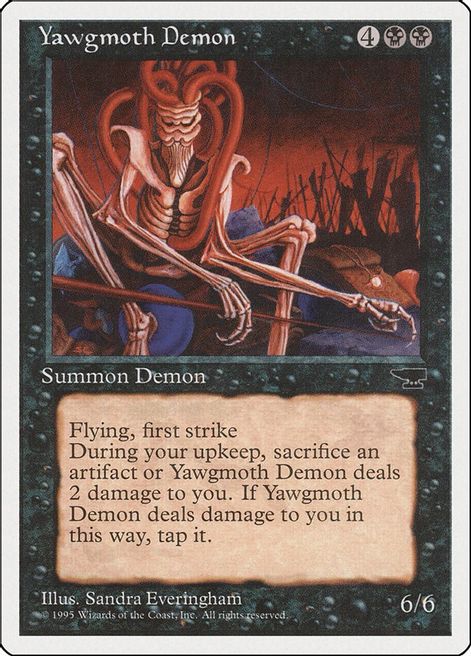
If you have NO background in this game, that photo means nothing.  If you have a background in this game, it probably ALSO means nothing, because these days that card is vastly overpowered by so much modern stuff.  But for little late 90s me, playing against my friend, at that moment in time, it was the most powerful thing I’d ever seen in the game. 


In the bottom right hand corner, you see the numbers “6/6”.  For a quick lesson in MtG: the first number is power, the second is toughness, the latter like “hit points” in a traditional RPG. Basically, when this demon hits another creature, it does 6 HP worth of damage, and it can also take 6 points of damage.  Up until this point, the strongest creature I had encountered in my deck was 2/2. 


This was unfathomably strong.  I could not wrap my brain around it.  How could this even exist?!  That flying and first strike thing was cool too, but I was locked into the 6/6. 


If you read the rest of the card, you’ll see something else: you have to sacrifice an artifact each turn, or else the Demon becomes “tapped”, which means it’s unable to fight AND it does 2 damage to you.  How very Faustian: an actual deal with a demon.  You have a contract that you have to abide by to get it to play right.


Pretty much like this

Here’s the thing.  I had NO artifacts at that time.


Here’s the other thing: since it was my brother’s random deck, I had no idea if I’d EVER have an artifact.


Here’s the other other thing: I did not care IN THE SLIGHTEST.  I played the Yawgmoth Demon right away.


This before this was this...and same outcome


And over the course of the game, it killed me.  I never drew a single artifact, and each turn, it kept dealing 2 damage to me until I died.


And as soon as I could scrap together enough cash, I went out and bought 4 of those cards: the max you could have in any deck.


Folks: I LOVE how late 90s me thought that day, at that moment, for that game.  THAT was the mentality I needed for SO much of my life.  I saw an opportunity for strength and I leap after it FIRST thing without question with NO plan whatsoever for failure.  There was no strategy, no trepidation, no hemming and hawing, no “wait and see”: I could NOT play that card fast enough.  I was gonna get strong now and figure out the rest later.


Solid plan


And yeah, it’d be easy to say that me losing that game that day was proof of how POOR a mentality that is, how it has no self-preservation behind it, how the outcome is being gradually killed by your own strength, etc etc, but we exist BEYOND just one game.  There was a follow-on: I went out and bought 4 more of those demons.  But even moreso: I also made sure I had a deck with some goddamn artifacts in it so I could USE those demons.  I LEARNED from the failure.  And the lesson wasn’t “this card sucks, I’ll never play it again”.  It was “This card is AWESOME: how can I make it work?”


And the big part of THAT is being able to not take defeat and failure so personally.  Failure is THE time to learn, so long as we drop our ego, admit our mistakes, and grow from it.  It’s totally fine to admit when you’ve been stupid.  In fact, “I’m stupid” is the common operating picture I try to approach ALL problem solving from.  Whenever I come up with a “brilliant idea”, I go back to the baseline of “I’m stupid” and then go “If I’m stupid and I came up with this, and no one ELSE has come up with it, and everyone else is smarter than me, why is this a BAD idea even though I think it’s a good one?”  In turn, if I take a program that has worked for everyone else and it doesn’t work for me, I immediately go back to “I’m stupid” and try to figure out what I’ve done wrong before I go “I’m perfect, it must be the program that’s wrong”. 


Yup: here we are


THAT is the real “failure plan”.  It’s not “what do I do when I fail”, but “what do I do to LEARN from the failure?”  The people that want to know how to fail a squat absolutely blow my mind: trust me, when the time comes to fail, your body will figure it out.  The people that want to know how to respond to failure in a program BEFORE it happens blow my mind.  What do you do if you don’t get all 20 reps of Super Squats?  I don’t know the answer, because we don’t know WHY you didn’t get all 20 reps UNTIL the moment happens.  The way forward from failure due to a pre-mature rack of the bar is going to be different from one that happened from true failure, vs one that happened because the bar slipped off the bar, vs one that happened because we blacked out at the top of the rep, etc etc.  We can’t prematurely plan for failure: we have to EXPERIENCE the failure first such that we can actually learn from the process.   And we don’t get to experience failure UNLESS we take risks.  And sometimes, risks pay off and we actually get the reward, so how cool is that?  But other times, the pay off of the risks IS the failure, and that’s cool too, so long as we learn from that failure.  Everything is a learning opportunity: we just have to allow ourselves TO learn.


I’ve played a thousand games since that day.  I even won a few of them.  I’ve gotten more powerful cards.  But, to this day, the Yawgmoth Demon STILL gives me chills.  It’s still what I think of whenever I think “strength”.  I still channel its spirit.  Because along with being a big strong scary demon, it’s a testament to the mentality of getting strong now and figuring out the rest later.   

Thursday, March 2, 2023

SUPER SQUATS 3: THE REVENGE

Folks, as of my writing of this, I am one workout away from finishing my third run of Super Squats.  What makes this one unique is that this run of Super Squats comes on the tail of a prior run, with a 6 week break in between: an idea proposed by the very author of Super Squats, Randall Strossen.  I wrote in a previous blog entry regarding Duality via Periodization on how I trained in between the two runs of Super Squats, effectively trying to UNDO Super Squats and prep for another run, and found that to be ultimately beneficial.   What was also unique about this run compared to the previous run is that I did NOT contract RSV at the start of it, nor did I tear my hamstring in the 2nd week, so I got to have my revenge and really give Super Squats the full “Mythical Strength” treatment.


There is that side of the equation too

I wanted to document how this run went and what lessons I learned from it, because that’s why we do these things.


---

HOW I SET UP THE TRAINING


You knew this was coming


I stuck with my 2 different training day approach, alternated in an A-B-A, B-A-B style approach.  Day A was a superset of axle clean once and strict press away with pull aparts, weighted dips w/axle rows, squats with pull overs, axle SLDLs, and poundstone curls, day B was a superset of incline DB bench and weighted chins, behind the neck press and pull aparts, squats and pull overs, and then an unbroken circuit of single set work of kroc rows into axle shrugs against bands into reverse hypers.  Each day also included standing ab wheel, glute ham raises, pushdowns, and some form of short conditioning work to end the training day.


Around the 5 week mark, I started cutting stuff out of the training days.  Biggest issue was my forearms/elbows from the frequent squatting.  They were in a significant degree of pain, and started limiting movement.  I removed weighted dips entirely, replacing them with a burnout set of flat benching with 20lb DBs (worked up to a max of 160 unbroken reps), and I’d play the Day A workout by ear on if I’d do the SLDLs or not. 


Week 5 was also unique in that it’s when I broke from the standard “Single set of 20, add weight next time” approach to one where I rotated between reps and different movements, once again in an attempt to spare my forearms.  I adopted an approach that had me do my heavy squat day on the first day of the week, then a lighter squat with 30+ reps for the middle workout, and then a Safety Squat Bar squat for 20 rep workout on Friday.  I’ll speak more to that later.


On the days between Super Squats workouts, I’d do 30 minute fasted conditioning workouts.  I almost never did the same one twice, and usually based it around what hurt the least to train and what could promote recovery for workouts.  On weekends, I found myself doing the Grace WOD from Crossfit with an axle pretty frequently, and would do some wild variations of it, like hitting it 3 times in a row with some burpee chins and swings in between or doing one every 10 minutes.  Pretty much just winging it.  I also practiced Tang Soo Do twice a week and had various other stints of physical activity.


Some examples

HOW IT WENT


About this good

If you care to watch the full run of the program, here is the playlist


With me starting at 335 for 23 reps, lighter weight allowing for higher reps as I broke into the program.


Without question, this was my most successful run of Super Squats, and one of my most successful runs of any program in general.  I hit some amazing lifts.  I feel the crowning achievement was 20x400lbs


Yes, I did in fact manage 20x405 later in the program


And it had quite a dramatic finish, but I absolutely dominated the set of 400 and felt the rep quality was high, whereas 405 was barely there, and I know I went short on the final rep just for the sake of getting the 20 in. Will I still count it?  F- -k yeah I will, but I also intend to come back sometime and get it clean.


Also got 35x315, which was gnarly


And in an attempt to top it, I did 33x315, then, after feeling sorry for myself for 20 seconds, got back up and got in 7 more reps for a total of 40


On top of all that, my incline dumbbell benching went from 3x12x95 to 110lbs, Behind the neck press from 3x10x120 to 145 and weighted dips capped out from 3x12x90 to 115 before I had to tap out from elbow pain.


My chins, rows and SLDLs also progressed incredibly well, but in that regard I entered the program recovering from a torn lat/tricep which had it so that I couldn’t do a single unweighted chin to start the program, and rows and SLDLs were stupidly light.  By the end of the program, I could do 2x15x25lb weighted chins, axle rows with 230lbs and axle SLDLs with 301lbs.


Oh yeah, and I didn’t weigh myself at the start of the program, but the day before the final workout I stepped on the scale after my post-workout shower and saw 201.0.  I still have ab veins.  I’ve never been this heavy and lean before, so that’s cool.


HOW IT WENT AWRY

Story of my life


As I’ve mentioned a few times now: elbow pain became the variable.  And I write “elbow”, but really, it’s more like forearm flexor/extenders.  It’s a byproduct of the stupidly low bar style of squat I employ, and I know it’s playing with fire whenever I do prolonged frequent squat workouts like this.  I experienced a similar issue on a run of Building the Monolith a while back.  It’s most likely why I tend to gravitate toward programs where I squat only once a week.


But I was also stupid in my conditioning exercise selection at the start.  I was doing a LOT of kettlebell cleans and snatches, and those TOO tend to jack up my elbows pretty badly.  Pairing them together on such an intense training program was a recipe for disaster, and once I crossed the point of no return on pain there was no course correction available aside from “drastic measures”.  Pain was beginning to influence training decisions, I was cutting movements out of the program or re-arranging things so that I wouldn’t go into the squat with so much pain that it distracted me from the set, and my conditioning became based around “what will hurt the least”.  I had to stop my daily ABCs or TABEARTAs for similar reasons. 


Eventually, after failing my first attempt at 405lbs, I had to make a change.  Now, that failure happened on an off-day as it was, since it was the president’s day holiday, so I trained in the afternoon rather than the morning, after a morning of “Top Golf” and different food than I normally have, but it was also the first workout of the program where I approached the bar with trepidation rather than an assurance that I was going to succeed, and it was due to the sheer pain I’d endure in simply UNRACKING the bar.


So I took a lesson learned from my previous run of Super Squats and decided to go for a set of 30+ reps.  That’s where the set of 35x315 happened, which was awesome, and I walked away feeling BETTER but not fully healed.  The next course of action was to use the Safety Squat Bar and completely remove the elbows from the equation.  That worked, and it was a challenging workout, but much like I wrote previously: the SSB just doesn’t create the same effect.  When you breathe at the top of the squat with the SSB, you can really rest.  You aren’t being crushed, you’re in a peaceful state, you can regather and recompose.  With a bar on your back, that time is murder.  I can’t see running a full cycle of Super Squats with a SSB being successful, but I can definitely see benefits of rotating it in as part of the program.  And in that regard…


LESSONS LEARNED AND FUTURE IDEAS


Don't listen to this heretic!


* Running a cycle of Super Squats where I worked up to 30 reps prior to this one was brilliant and totally unintended.  It legit made 20 reps feel mundane.  I was so used to the work STARTING at the 20 rep mark that I’d often not realize I was “done” with my set until around rep 18 or 19.  And they were STILL hard sets of 20, no question, but, mentally, there was no battle whatsoever.  I was conditioned to not even think about those first 15 reps, since they were “halfway” to the end and I didn’t want to get into my own head before that time.


* There’s nothing wrong with some short conditioning sessions between Super Squats workouts to keep appetite high and recover from training, but movement selection is crucial.  Death by a thousand cuts can happen, and once you’re on the wrong side of it, it’s too late to fix.


* I didn’t write about nutrition, because mine is so stupidly nuanced and insane that it’s cumbersome to do so, but I once again did not do the gallon of milk a day, and I once again say that, if you CAN, you should.  I was pretty much eating non-stop through the program.  If I had to work late, my whole evening got compromised and I would end up literally spending the time I got home to the time I went to sleep eating (I say without hyperbole, I’d eat my last meal, go upstairs, brush my teeth and go to bed.  All the people worried about eating before bed messing with their sleep can f- -k right off.)  I had a lunchbox full of food that I’d bring to work and eat something at least once an hour out of it, to say nothing of the snacks I kept in my desk, to say nothing of the gigantic breakfast I had BEFORE work.  And after I ate breakfast, I would do the dishes, have a snack, get my kid in the car, drop them off at school and then eat my CAR SNACK on my way to work, where I’d eat my “I got to work snack” as soon as I sat down.  People: a gallon of milk a day is so much simpler.  Also, I need to get sponsored by Nuts ‘n More, because I was going through a container a week, easily.


* At one point, squatting around 400lbs every other day for 20 reps just takes a toll on the body that cannot be recovered from if one is not drinking a gallon of milk a day (still gonna keep plugging that).  Next time I run Super Squats, I want to try an approach where I have 3 distinct approaches to the squat.  The first day of the week will be a traditional 20 reps.  The next day will be a lighter weight for 30+ reps.  The final day will be the Safety Squat Bar for 20 reps.  This is the layout I used for the last 2 weeks of this run of Super Squats, and I think it has a TON of merit.  Primarily, that heavy set is the first one of the week, so I effectively have 6 days to recover from it before I have to do it again.  Yeah, the middle workout is still a barbell squat workout, but the lighter weight is far less taxing on my elbows, and the SSB is completely forgiving of it, so I get to spend a lot of time healing/recovering.  As far as progression goes, I’m thinking 10lb jumps each week for the sets of 20, and going up a rep or so a week for the high rep work.  I’ve considered making the workout 1 and 2 weight the same at the start of the program and going from there as well: hitting 20 reps with it on workout 1, 21 on workout 2, and then when workout 4 rolls around go up 10lbs, then going up 1 rep on workout 5.  Lots of ways to succeed.  There’s also the possibility of swapping out the SSB day with a trap bar day too.    


* Randall Strossen’s idea of “6 weeks of Super Squats, then 6 weeks of a 5x5 bulk and power program, then 6 weeks of Super Squats” is right on the money.  I really overlooked that gem the first time I read the book, and even the second time, but after enough re-reads it really clicked, and this was a fantastic experiment in that regard.  You don’t need to run the exact 5x5 bulk and power program, but take the lesson it’s presenting: do a program with 1 set of a lot of reps, then do a program of a lot of sets of few reps.  It was stupid simple periodization and it was there all along.  And keep reading the rest of the book, where Randall talks about doing 2x15 or 3x10 or 1x30 and you see all the ways you can keep making Super Squats “work”.  That book, no joke, should be the first book any serious trainee reads regarding training.  It gives you a plan you can follow for life and imparts SO much knowledge.