Sunday, January 20, 2019

FORCE OF NATURE


This is going to be another one of those free form word association posts ala “blunt force instrument”, so stick with me.  Going with full disclosure again, my unabashed nerdiness comes through on this one, and my very first encounter with the term “Force of Nature” originates from Magic the Gathering, but, in fairness to the respect of the content of this blog, that Force of Nature was pretty jacked, and incredibly powerful

Image result for magic the gathering force of nature
Some Jon Andersen style traps there

But what is an actual force of nature?  The literal definition applies to those natural forces beyond the control of humans that tend to have cataclysmic effects, such as hurricanes, tsunamis, volcanic eruptions, etc.  When applied figuratively to people, it implies that those people have qualities and personalities similar to these natural disasters; existing beyond the control of outside forces.  In turn, those with these qualities tend to exhibit qualities of being unstoppable insofar as it comes to the expression and execution of these qualities.  One tends to not be a force of nature in regards to all qualities, but instead possesses a quality, of which they are a force of nature for that quality.   

Where have you observed forces of nature?  In fiction, my two favorite go-tos are Jason Vorhees of Friday the 13th fame and Frank Castle, aka The Punisher.  Jason starts out as more the figurative Force of Nature, as his original appearance is that of a human driven purely by a murderous drive for revenge against those that were responsible for the death of his mother.  However, as his story progresses, he transforms into an almost literal interruption as a re-animated corpse that seems driven for murder against teenagers and authority figures.  The original driving purpose was lost, and Jason now murders simply because that is what Jason does.  And, as a Force of Nature, he is almost entirely unstoppable in his pursuit.  He lumbers after his victims, smashes through walls, and lets nothing stop him on his quest.


F**k your boombox


Anyone familiar with me is well aware of my obsession with The Punisher, so it should be no surprise that he’s my other reference for what a Force of Nature is.  But it’s worth analyzing, as it’s easy to get caught up in the initial motivation of Frank Castle and miss out for what it is he becomes.  Yes, Frank’s original motivation was to avenge the deaths of his family, and there are many that would argue that is perhaps noble and respectable.  But then, it becomes a quest to far a war on crime, which becomes a bit morally complex depending on your views on vigilantism, but some could argue this was just an extension of the avenging of one’s family.  But eventually, 30 years have passed, Frank can’t even remember what his family looked like, the original purpose is long since expired, anyone that was in anyway related to the death of his family is dead, and Frank fights the war simply because that is what Frank does.  He is a Force of Nature for punishment.  He is under no delusion that what he does is somehow better than the acts of those he punishes: he just knows that what he does in this world, his sole purpose, is simply to punish. 

So this was a lot of rambling, nerdiness and pop culture.  Why talk about it?  Because the Force of Nature helps obviate the dread of existentialism in an otherwise absurd world.  And, of course, that sentence is yet more nerdiness, but what does it mean for you?  The Force of Nature is self-justifying.  It requires no explanation, justification, reasoning, or logic, for it simply IS.  The Force of Nature does what it does because that is what it is, and to be anything else is simply outside of its nature.  And, consequently, this means that nothing else will make it anything other than what it is, as it is immune to the effects of outside influences.

Image result for squatting on a bosu ball
Although maybe sometimes you should still listen to outside influences..

When you make yourself a force of nature, you grant yourself the freedom of no longer needing reason to do what it is that you do.  How often have you observed the meltdown of a trainee when they hit the existential dread of training?  When it dawns on them that they’ve bit off on a lifetime of training and nutrition in order to continue achieving what it is they want to achieve?  How many early mornings do that need to have?  How many missed nights out drinking must they endure?  How many possible injuries, annoyances, missed meals, etc etc, are they in for?  But these aren’t concerns for a Force of Nature, for they simply do what they do because it is what they are.  They get up early or train late, they eat the same thing everyday, they abide by the program, stay on the diet, endure, adapt, overcome, get hurt, come back, etc etc because they are a Force of Nature, and that is what they do.

And when the question of “why” gets asked, the answer is simply “because I am”.  I long ago lost the reason of WHY I want to be big and strong.  All I know is that it’s my earliest memory.  It’s simply what I am.  I no longer carry the burden of needing a reason, and it frees me to spend my energy thinking of HOW I will pursue my ends rather than why.  Give yourself the same gift.  Lose your purpose and simply be.  In doing so, you are beholden to no one’s standards but your own.  You will overcome injuries because they do not stop a Force of Nature, you will overcome adversity, lack of opportunity, limitations, etc etc.  You will overcome your OWN internal monologue, questioning why it is you do what you do, for what purpose, for what end.  There is no reason, there is no purpose, everything is absurd, your life will end, the sun will explode, we will all perish…

…but none of that matters anyway.    

Sunday, January 13, 2019

ON YOUNG TRAINEES


Since this is my blog, I get to be self-indulgent, and this is one of those times.  I’m at the ripe old age of 33, but I’m going to use this as an opportunity to get on my old man rage and talk about “back in my day.”  Why?  Because I spend an inordinate amount of time on the internet, to the point that I now observe trainees that were the same age when I started training, and through these observations I’ve noted some bizarre trends that are completely hamstringing young trainees.  No matter how much information we make readily available, problems always exist with all levels of trainees, and more information just results in new problems.  In fact, I feel it’s to the point that new trainees need to quit learning so damn much and just do like we did before all this information was out there; experiment, fail, learn and grow.

Image result for Muscle and fitness Derek Poundstone
This used to be where to get the "latest and greatest information"

One of the primary issues I observe with new trainees is a massive pre-occupation with the programming of their training.  They get it in their head that programming is the most critical aspect of programming, and the key to their success.  They believe that any sort of miscalculation will result in years of failure and regression, that they have a finite amount of “newbie gains” that can be exhausted on poor programming and result in stagnation and terminal “skinny fatness”, they believe the only way worth training is the most optimal way to train, etc etc.  What’s the issue with worrying about programming?  This preoccupation with programming typically comes at the expense of NOT being preoccupied with knowing HOW to move.

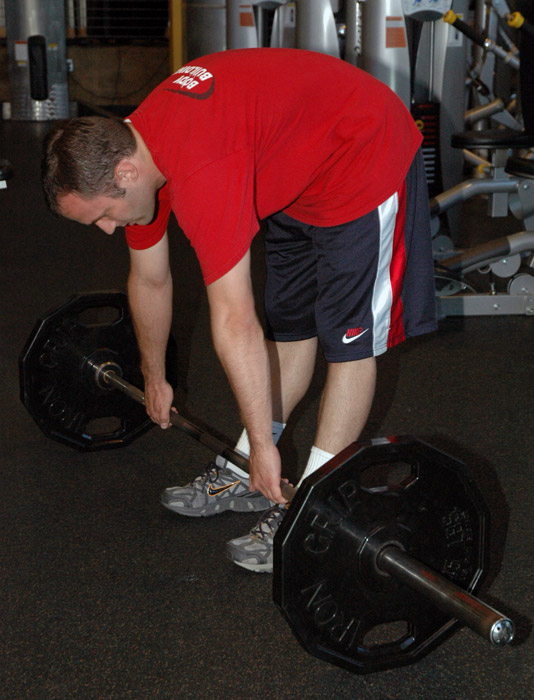
I’ve observed a trainee ask approximately 1000 questions on 5/3/1 for Beginners.  For those of you that are not “in the know”, 5/3/1 is marketed as the simplest training program for gaining raw strength and size.  The “for Beginners” variation of that would be the even SIMPLER version of the simplest training program for gaining raw strength and size.  It is spelled out set for set, rep for rep, exercise for exercise, you are told what day to train per week, what to do on that day, etc.  That ANY question can be asked about the program blows my mind, let alone the amount of questions I observe about the program on a daily basis.  One fateful day, among the myriad of questions this trainee asked, he asked about substituting deadlifts out of the program.  Through his trails and tribulations, he had deduced that the deadlift was simply “not for him”, and he needed a new movement for the program.  When prompted to post a form check, he uploaded a video of him deadlifting that looked like a cat dry-humping a barbell.  He literally could NOT hinge at the hips, all movement stemmed from his lower back, he couldn’t even bend down to reach the bar without significant rounding, etc.  Hours spent researching programming, not a second spent learning how to move.

Image result for awful deadlift
"Hey guys, my deadlift has stalled at 135: should I run deadlift Smolov or Coan/Philippi?"

And this preoccupation with programming stems from a problem that IS as old as time when it comes to new trainees: emulating the more experienced trainees.  Before, the issue was that new trainees would just directly copy the training programs of experienced trainees and burn out because they lacked the work capacity, but now new trainees simply ape the mentality and mannerisms of experienced trainees, and with that comes another new bizarre trend in young trainees: pre-mature aging.  What do I mean here?  There are 15 year old trainees that, if you hear them talk, you’d swear they were 80 years old and worked in a coal mine their whole lives.  They talk about how they have bad knees and can only front squat, bad shoulders so they can only use a swiss bar and safety squat bar, lower back problems so they only belt squat and do romainian deadlifts, etc.  Jesus Christ, what did you do in 15 years of living to do this?  I’ve trained for 19 years and I’m not that broken.  I have a right shoulder with a torn labrum after 6 dislocations and a dozen subluxations, and I have the shoulder mobility to low-bar squat and press with a straight bar.  I blew out my knee so bad that they could not FIND my ACL in my MRI and I can still squat.  How did you get so old?

The internet, of course, makes this behavior self-validating, because these ancient teenagers get online and find others just like them and keep agreeing with each other.  They’ll all lament about how they can’t run certain programs because they can’t do the movements in them, they’ll help each other come up with replacement movements, they’ll find someone even YOUNGER than them and caution them with their years of wisdom to “not do like they did”, etc etc.  Why is all of this?  Because these trainees observe guys like Dave Tate, Ronnie Coleman, Steve Pulcinella, Ed Coan, etc, being broken and assume it’s some sort of badge of honor that comes with getting big and strong.  They’re in such a rush to be just like the big boys that they can’t WAIT to be crippled and lame.

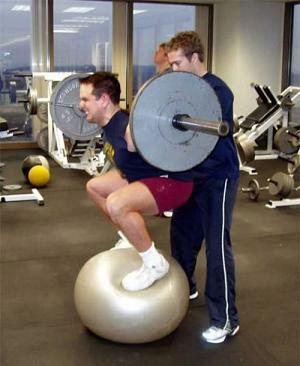
Image result for squatting on a bosu ball
This should do the trick

Once again, this stems from a lack of patience in what really matters for young trainees: learning how to actually MOVE.  So much of these aches and pains are due to poor execution of a movement pattern, NOT the inherent danger contained within these movements.  This gets to be my old man rant again, but a lack of patience among young trainees stems primarily FROM their youth, specifically as it relates to their perception of time.   A young trainee decides that they have to give up on a movement because they “tried figuring it out” and it just didn’t work.  When you ask them how long they spent trying to figure it out, they say 3 months.  It’s easy to scoff, but when you’ve only been training for 9 months, that seems like FOREVER.  And when you start out training not knowing how to move your body in general, 3 months spent “learning” a movement is really just 3 months spent screwing up a movement.  So what ends up happening?  These young trainees amass a HUGE list of “off-limits” movements for training at an incredibly young age and completely hamstring themselves from any growth, and their brokenness becomes self-perpetuating. They lock themselves into bizarre movement patterns and habits and lose out a significant degree of basic mobility (but don’t worry: that can be fixed with a mobility routine!  Another rant, for another time).

Wrapping up the old man rant, what we’re observing is the ramifications of a lack of athletics and genuine “play” among adolescents.  These basic movement patterns used to be reinforced by going outside and playing, climbing trees and playground equipment, running around, and playing a variety of sports.  Instead, trainees spent a significant degree of their youth sedentary, then reach an “oh crap” moment where they realize their youth is escaping and they look and perform like junk, and try to reverse it.  They’re sold a pack of nonsense that they’re running off “natural steroids” as a teenager, and that they MUST maximize this by weight training as hard as possible, run into all these issues because they don’t know how to move, and thus the above happens.  Instead of trying to find the most perfect program, instead of accumulating a list of fake injuries, instead of ruling out 90% of training movements, these trainees need to go become athletes.  They need to move through space, resist another human attempting to score points, move laterally, etc etc.  THIS is the beginner foundation, THESE are the “beginner gains”, and with this they’ll actually be set up for success.  They’ll also learn what a real injury looks and feels like, and the difference between pain and strain.  And, of course, they’ll hate this advice, because they want to train like all the big names in lifting…but hey, guess what THEY did?   

Sunday, January 6, 2019

BECAUSE I DON’T HAVE TO


One of my favorite bits of media regarding training was the interview series Elitefts put on where Wendler did a Q&A session with Kroc.  And in that series, my favorite moment comes right away in part II, where Wendler asks “Why don’t you wear knee wraps” and Kroc offers an impish smile before responding “because I don’t have to.”  You can watch it here


Let me set up some context for you, for those that aren’t totally versed in the Kroc lore.  At the time of this interview, Kroc had already out-totaled the person interviewing him, and did it at 2-3 weight classes lighter.  He had placed/won in the WPO at the Arnold, which, at the time, was the biggest powerlifting competition in the world.  Raw (or RAW, for those of you with simple minds) wasn’t even a thing, the IPF was single ply, and the top strongest dudes in the world who wanted to compete against the others did it in multi-ply at the WPO.  There was NO restriction on gear; wraps were certainly allowed.  After this interview, Kroc would go on to set the all time record total, and did that ALSO without wraps, even though they were allowed.  Every single person Kroc competed against used wraps, and used them to their advantages.  By all reasonable measures, using wraps made sense.

Image result for matt kroczaleski squat WPO
Kroc, seen here, not making sense

To this day, it remains the best possible answer I’ve ever seen to any question of “why don’t you do X.”  There’s no refuting it: all Jim can do is chuckle, because really, what else can you say to that?  And the response came so quickly.  Kroc didn’t have to sit and think, weigh the pros and cons of wrap use, justify his practice with facts, figures, studies (Russian and otherwise), historical precedents, words of gurus, etc etc: the answer was rapidly ready and justified itself.  This interview happened well over a decade ago, yet its wisdom has sadly been lost or never even realized among the training population in the first place.  Last year, I gave you all the mantra of “brute force and ignorance”, so how about for 2019 we embrace “because I don’t have to.”

“Because I don’t have to” is about understanding what is of real value in your training and your life.  So many trainees cram their training with all sorts of meaningless drivel simply because it’s THERE. Without any need for it, they engage in half hour warm ups with 400 mobility drills and foam rolling, they throw in every single gimmicky piece of training gear they can into their workout, they calculate MRV and compare outputs on their tendo units, etc etc.  They do all these things despite the fact that they were progressing BEFORE they started implementing them, or they implement them before they even try training without them.  And suddenly, they’re trapped in a routine of a million different movements that takes 4 hours to complete and they have no idea how else to train, they burn out, don’t have any time to train anymore, and ultimately still look like they’ve never actually set foot in a weight room before.


Image result for squatting on a bosu ball
Clearly, at some point, someone should have asked "Do I have to do this?!"


Everything has a place, but everything also has a TIME, and you need to recognize when that time is.  If you try to do everything all the time, all you end up being is bad at a lot of stuff at once.  This is very very basic periodization, and trainees HATE the idea, because all they ever look at is a finished product.  Its super cool to look at Arnold or Mariusz or Kaz and go “why can’t I be big, strong, and a total freak just like them?” but the individual needs to realize that they’re looking at a finished product of work that stems from MANY decades of training, and in turn they’re observing them at their peak in THAT moment.  Even mighty Arnold lost his abs in the off season, and Mariusz had to learn how to fight when he got into MMA, and he got smaller through that process.  These guys did what they had to do WHEN they had to do it.

And on the converse of that, there’s no shame in NOT doing something you don’t have to do, even if everyone says you have to.  Ok, that previous sentence was a triple negative, so let me explain.  I am notorious for doing zero mobility work, never warming up in competition, barely warming up in training, and having “bad form” as far as the internet is concerned.  I never hit depth on squats in training, I don’t push my head through on overhead presses, my back rounds frequently, etc.  And why is that?  Because I learned a while ago “I don’t have to”.  These are things I simply don’t have to do if I want to succeed and meet my goals.  And it GREATLY upsets vocal members of the internet, because it causes them cognitive dissonance to see someone succeed NOT doing what they do.  And they will get violently upset about it, and call me all sorts of horrible names and insult my intelligence and legitimately wish harm upon me…because I train differently than they do.  I like to think of myself as crazy, but these people are certifiable. 


Image result for stop liking what i don't like
How I view these exchanges

Look; I’ve not ruled any of this stuff out.  I’m sure it has a place: I just don’t have to do it.  Not right now.  “Yeah, but you’ll WISH you did it later”.  Dude, it’s been 19 years; I’m not sure how much longer I can train the “wrong” way before I start suffering from it.  I have too many things I HAVE to do right now to start wasting any of my training time and effort on things I don’t have to do.  And what I have to do is going to be different from what you have to do, or what other trainees have to do: we have our own weaknesses to bring up, and our own strengths to fall back on.  Your job is to be able to sort out the signal to noise out there and know what is what YOU have to do.  Every year, something becomes the new “thing”, and everyone starts doing it, and everyone who doesn’t do it is an idiot living in the past…and then another year passes, that thing falls to the junk pile, and a new thing takes its place.  Don’t fall for these traps; learn what YOU have to do, and do that.

Give yourself your own interview this year, and see how many questions you can respond with “because I don’t have to.”  For those that you don’t have that response, you now recognize your weaknesses and what you need to improve on.  If you ask yourself “Why don’t I do more conditioning work” and your response is “Because I don’t have the time/I’m lazy/it sucks/I don’t like it” etc etc, you’ve hit step 1 of the 12 step program and identified you have a problem.  But, if you ask yourself a question, look at you current trajectory and find yourself satisfied with your course, you can fire back with “because I don’t have to.” 


Sunday, December 30, 2018

IN OPPOSITION OF THE PUSH PRESS: AN ARGUMENT FOR STRICT PRESSING


First, a rant.  I will be discussing the strict press, or press, today.  Not the Overhead press, or OHP.  Why?  Because OHP is not a lift: it is a classification of lifts.  Specifically, lifting of weights over one’s head.  There is no one lift known as the OHP: ANY lift over one’s head is an overhead press.  Strict press, push press, log, axle, etc etc: all overhead pressing.  This is why, when internet nerds freak out at a 400lb overhead press because “they used leg drive”, they show that they are weak AND stupid.  Pressing without leg drive overhead (a strict press) has never been known in any traditional circles as “the overhead press”, but was instead simply “the press” back in the era when they lift was included in the Olympics.  Also on that topic, can people PLEASE stop lamenting about how pressing overhead is no longer a competition lift: you folks ever watch a strongman competition?  And, of course, there’s always Mark Rippetoe’s “Strengthlifting” federation…I feel so dirty…

Image result for Rippetoe double bend press
"Strict" press...

I’ve started wearing my glasses again, and had to push them WAY up my nose for that rant.  Anyway, more to the point of today: an argument in opposition of the push press.  It’s should be of no surprise that I, a self-admitted oaf, oppose anything that requires coordination and skill in support of the more basic and brutal variation, even if the end result is less weight moved.  But it’s worth analyzing the cons inherent in the focus on the push press.  As noted, more weight gets moved in the push press, which tends to make it a preferred lift for MANY trainees compared to a strict press.  Ego is very much a thing, and for many trainees, when they set up for a working set of strict presses, they load an empty bar with some nickles and dimes rather than the big plates, whereas once the push pressing starts, some of the heavier weight can start getting added to the bar. 

And hey, speaking of ego, there’s a weird new form of ego out there where lifters take pride in NOT building muscle?  Doubt me?  Think of how many trainees are in a race to talk about how they don’t do any curls.  Or how they don’t care about building “mirror muscles”, and they just want a strong posterior chain.  The ironic to the point of critical mass focus on the glutes while doing everything possible to NOT build the pecs.  We’ve bred a generation of counter cultural lifters that are trying their hardest to NOT look like they lift, so they can prove how hardcore they are about lifting?  What the hell?  And why do I bring this up?  Because to develop a strong strict press, you NEED to develop all those horrible “mirror muscles”.

Related image
The goal of the current generation

Doubt me again?  Think about it for a second: the lamentation about the “slow rate of improvement” in the strict press is due to the “small muscles” involved.  The primary movers are going to be the delts and triceps, with the back and rear delts providing the counter balance.  Before you science nerds go any further, I got a C in biology, my undergrad and masters are in POLITICAL science, and I’m sure you’re much smarter than me.  Back on topic, yeah, those muscles ARE small…if you let them be.  BUT, what if you make them bigger?  You suddenly have a VERY impressive physique.  A dude with big shoulders, big triceps, a big back and big rear delts is JACKED.  Think of every strong presser you’ve seen and think about how impressive their upper body was.  Kaz was inhuman, Big Z and Eddie Hall were basically strict pressers, Radzikowski, etc etc.  Also interesting to observe is the change in physiques with weightlifters in the era when press was a competition lift compared to the current generation.

Image result for bill kazmaierImage result for radzikowski krzysztof
I'm certain my blog just attracted a whole new demographic with these photos

The push press though?  Don’t get me wrong; it’s a good idea to develop those same muscles to make sure you can achieve a stable lockout, but most trainees tend to overemphasize the muscles involved in the leg drive rather than the actual pressing/locking muscles.  Some take it steps further, and focus so much on the execution of the lift that they effectively turn the push press into a jerk, driving with the legs, then diving under the bar to lockout again (the “double dip”), effectively removing the upper body pressing muscles from the equation.  Once again, much weight moved overhead…but how much strength are we building here?  Did we, instead, develop power?  Certainly an admirable physical quality, but also a DIFFERENT one, and one must be aware of this in their training.

So why do I argue against training the push press in favor of developing the strict press?  Aside from the benefits inherent to the physique, when you take the time to make those “small muscles” bigger, you’ll also find that strength in the strict press is more reliable than strength in the push press.  The example I love to provide stems from my 5th strongman competition, wherein our first event of the day was a squat for reps, followed by a press medley.  Athletes found themselves floundering on lifts they had crushed in training on the plus, as now their legs were fatigued, and their ability to drive the weight was compromised.  When they tapped into the well of shoulder strength to find a way to get the implement overhead, they came up empty.  All that time spent emphasizing their ability to move as much weight as possible overhead came at the detriment of their ACTUAL ability to get weight overhead, as they developed legs and power, but no for real pressing strength.  I ended up taking first for the first time ever in a press event, because these were weights I could still strict press.

Image result for Fry a world of spelling errors
Alternative Matt Groening punchline: "Strict pressing: that's where I'm a viking!"

The unreliableness of push pressing doesn’t just extend to fatigue legs, but to implement as well.  The master of a weightlifting bar can move a tremendous amount of weight overhead by relying on bar whip and precision timing, along with keeping the bar as close to the body as possible, to generate as much possible vertical force as they are able.  However, with the axle, the implement is stiff, there is no whip, and the bar is further out in front.  With the log, the implement is even further away, the hand spacing is wrong, and again, there is no flex.  A sandbag?  Forget about it.  But actual raw pressing strength?  It’s a universal; you’ve made those small muscles big and, in turn, developed an ability to manipulate any mass in any shape over your head.

And perhaps this is all very obvious to you, but from my observation, it seems many miss this point.  “I’ve been stalling on strict pressing: does push press have any carryover?” “I just started push pressing, and I’m FINALLY seeing progress moving weight overhead”  “I don’t spend time working on my strict press, because it’s just weight overhead that matters”, I’ve seen it all, and thus I argue against the push press in favor of the strict.  Take a page from some bodybuilders and build a big set of shoulders, triceps, traps and back.  Take some weight off the bar, swallow your pride, and grind some weight overhead.  Let your back bend some, do some “dangerous” behind the neck pressing if you can, do a ton of raises, pull aparts, etc etc.  Up the volume and up the food.  Build a big, strong STRICT press, and I’ll bet your push press will get better too.

Sunday, December 23, 2018

NO RESPECT


(Hey folks, full disclosure, I started writing this post, got hit with a stomach bug midway through, and finished it in between bouts of vomiting and delirium.  If it sounds crazy, it probably is.)

I’m really tempted to open this one with a Rodney Dangerfield bit, but he was too awesome of a comedian for me to butcher one of his routines for my blog.  Instead, go watch “Back to School”, one of the greatest 80s college movies ever, featuring a very young Robert Downing Jr and home to one of the best scenes ever that summarizes the whole “experience vs education” paradigm.

 I live this experience constantly

Anyway, what I’m here to discuss today is the concept of NOT giving respect to certain lifts.  The two biggest issues I see this in are the bench and the strict press (known as the Overhead press to many…despite being silly, considering there’s no such named lift and overhead press refers to any manner of pressing a weight overhead).  Trainees get themselves so wrapped up on these two lifts, get in their own heads, spin their wheels forever, make zero progress, and come up with zero plans for success.  Meanwhile, I’ve got Stretch Armstrong arms and a right shoulder that is effectively hamburger after a torn labrum, 6 shoulder dislocations and a dozen subluxations, and I’ve never encountered the struggle that trainees run into with these lifts, and I attribute this to the fact that I’ve NEVER considered them somehow special compared to any other lift.  These lifts get no respect from me; why do they get it from you?

Let’s start with the bench, because hell, everyone else does.  (That’s a Monday “international bench press day” joke, and yes, I hate myself for making it).  I’m by no means a great bencher, but I’ve bypassed many of the stalls other trainees have hit and, specifically, I’ve done it knowing absolutely nothing about benching.  I hit my first 300lb bench at age 18, on a standard bench press (as in, 15lb non-olympic barbell and skinny bench) with zero arch, following a program of basically 10 heavy triples, and then some tricep work.  I did it as a dare from my dad, after hitting a 275 max in the fall of my freshmen year of college and then just stalling there until the summer.  It was only after doing this that I got on the internet that I heard all the typical moaning of “I hate the bench/it’s a dumb lift/who cares about benching anyway” etc etc.

Image result for j.m. blakely powerlifting usa
Not like benching builds a solid physique or anything...

Holy crap, the bench press isn’t that hard folks. It’s a lift in the special AND para Olympics; it can literally be done by anyone.  Yeah yeah, sure, if you wanna super duper powerlift it, you’ll need to master your arch, grip the bar, set your lats, perform 8 voodoo rituals, spray hairspray on the bench, etc etc, but if you just want to bench?  Go to any gym, anywhere on the planet and you’ll see guys doing it.  “But they’re doing it wrong!”  Maybe, but are they benching more than you the “wrong way”?  It just means the gap will be even crazier once they do it the right way.  So maybe, just maybe, you need to take a lesson from them instead.

“But I already say I hate benching; aren’t I disrespecting it enough?”  No you fool; you are being BULLIED by the bench press.  Hate isn’t the opposite of respect, hate is just a few degrees off of love.  The opposite of respect is apathy and ambivalence.  The dudes benching with flat backs and flared elbows clearly don’t give the bench any respect: it’s just laying down and pressing.  The “trick” is to just get big and strong.  If you get strong pecs, strong shoulders and strong triceps, you’ll probably have a strong bench press.  You’ll PROBABLY even get it even IF you only bench press once a week (GASP!) because you’re following a “bro-split” (DOUBLE GASP!) that has you hitting chest once a week, despite the fact that the internet swears up and down on a stack of Bibles that you MUST bench press 3 times a week if you ever want it to grow.  Quit respecting the bench so much that you have to fit your training schedule around it and start making it grow on YOUR time.

Image result for scott mendelson pec tear
Ok, so SOMETIMES the bench gets to decide the schedule

The press is the same damn animal.  I legit did not do any manner of overhead pressing until I was a college senior, and only because at that point I had read “Beyond Bodybuilding” by Pavel Tsastouline, where they were described as quite the bee’s pajamas.  My very first workout, I managed to hit 135 for an easy 5x5 (once again, Pavel).  And then, years later, I saw people online stalling at 95lbs for even fewer reps, only for the internet to assure them that it was ok, the press was just a lift that was impossible to progress on, and it was VERY uncommon to just reset the weights, 4, 5, 6, 900 times before you actually make some progress. 

What the hell is wrong with you people?  It’s just a press overhead.  It’s literally the most instinctive thing to do with a weight.  At my 6th strongman competition, we were at an outside venue, and a methead wondered onto the scene, spotter a barbell loaded with some bumper plates, and proceeded to clean and press it overhead a bunch of times.  Two points of interest are that the weight he used was above a stalling weight most internet denizens encounter while training “the right way”, but also of interest is that, when I paid the dude $10 and told him to go get some lunch, he gave me a bro-fist pound and proceeded to do 3 BACK HANDSPRINGS away from me before running down the street to Carl’s Jr.  It was honestly the most athletic thing I ever saw at a strongman competition.

Image result for jack3d
And here you suckers were running imitation meth...

Quit giving these lifts respect and treat them like any other thing: expect results!  If you go into your training anticipating failure, it’s exactly what you will get.  If you go in thinking that of COURSE your bench and press are going to go up, they will as well.  Learn from the meatheads in your gym that figured out that, if you make the muscles involved in pressing strong, you’ll get strong at pressing.  Treat the lifts without respect and you will develop lifts that are respectable.